

When Dizzy Gillespie and Miriam Makeba appeared together in the early 1990s, it wasn’t the launch of a long-term project, nor a carefully branded collaboration. Instead, it was something more fluid, and incredibly joyful – as the video below shows.
Across a short period around 1990–91, the two artists shared stages, recordings and festival appearances, bringing together very different musical traditions at a point when both were well into the later stages of their careers.
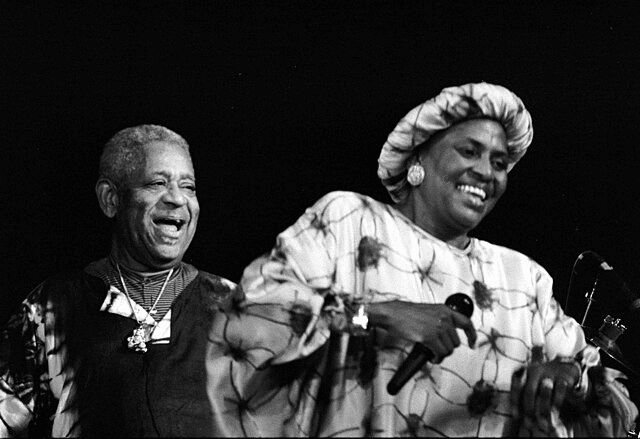
What emerges from these encounters isn’t a single defining statement, but a snapshot of how jazz, by that point, had become a genuinely global language.
Two Careers Moving Towards Each Other
By the time of these performances, Gillespie had long been one of the most recognisable figures in jazz history. From his role in developing bebop in the 1940s to his long-standing exploration of Afro-Cuban music, his career had consistently moved outward, absorbing new influences and reshaping them within a jazz framework.
Miriam Makeba – known affectionately as Mama Africa – had a career which followed a very different path. Emerging from South Africa in the 1950s, she built an international reputation not only as a singer, but as a cultural and political figure. Her music blended traditional African material with elements of jazz and popular song, while her exile during apartheid turned her into a global voice for South African identity and resistance.
By the late 1980s, both artists were operating in a space that went beyond strict genre boundaries. So when they came together, it wasn’t a stylistic clash — it was a meeting of parallel trajectories.
A Brief but Real Collaboration
While there’s no evidence of a long-term touring project, there is clear documentation of collaboration between Gillespie and Makeba during this period.
Most notably, Gillespie appears on Makeba’s 1991 album Eyes on Tomorrow, recorded in South Africa during a significant moment in her return from exile.
At the same time, the two artists were appearing together in live settings. Festival archives confirm a joint billing at the North Sea Jazz Festival in July 1991, presented as part of a programme titled “The Live Future.”
There are also documented appearances in France and the US around the same period, suggesting that this was not a one-off event, but rather a short-lived phase of collaboration across different contexts.
What’s notable is how loosely structured all of this appears to have been.
Rather than forming a fixed ensemble or touring unit, Gillespie and Makeba moved through a series of performances and recordings that reflected the flexible, networked nature of jazz at the time — particularly at major festivals, where artists were often brought together for unique combinations.
Jazz as a Global Language
To understand why this collaboration works, it helps to zoom out slightly.
By the 1990s, jazz had long since expanded beyond its origins as an American art form. Gillespie himself had played a major role in that process decades earlier, helping to establish Afro-Cuban jazz as a central strand of the music.
Makeba’s music, meanwhile, represented a different kind of globalisation — one rooted in African musical traditions, political history, and the experience of exile and return.
What brings these two approaches together is rhythm.
Whether through Gillespie’s work with Latin percussion or Makeba’s grounding in South African song forms, both artists operated within musical systems where rhythm and collective interaction were central. The result is a shared space that doesn’t rely on stylistic uniformity.
Instead, it allows contrast to function as a creative force. That’s what makes these performances compelling: they’re not about blending everything into a single sound, but about allowing different traditions to coexist within the same framework.
A Working Band, Not a Tribute Moment
Another important detail — and one that often gets overlooked — is that these performances are not framed as retrospectives.
By the early 1990s, both Gillespie and Makeba could easily have been positioned purely as legacy figures. Gillespie was in his seventies, Makeba had already lived through multiple phases of her career, and both had long-established reputations. But the available footage and reports suggest something different: an ongoing, active musical practice — not a symbolic appearance or a nostalgia-driven set.
Positioned within a major festival setting, it captures both artists in a live environment that prioritises interaction, communication and immediacy — the core elements of jazz performance, regardless of era.