

In the summer of 1959, Miles Davis was on top of the world: he’d recorded Kind of Blue earlier that year and was headlining at New York venue Birdland. Days later, he was brutally assaulted by police outside the club. Through newspaper reporting at the time, as well as eye-witness accounts (see video below), we can piece together an all-too-familiar story of discrimination against Black musicians.
The recording that changed modern jazz
Kind of Blue was recorded over two sessions in March and April 1959. The lineup was exceptional: John Coltrane, Cannonball Adderley, Bill Evans, Wynton Kelly, Paul Chambers and Jimmy Cobb. The material was built on ideas the band had been playing live, and the sound was stripped-down: modal frameworks, fewer chord changes, more space.
The result became the most well-known jazz album of all time. Five tracks, recorded quickly, with a focus on mood rather than complexity. The record was still new when Miles opened his run at Birdland that August.
Birdland was one of the most visible stages in American jazz. A headline slot there was a marker of status. Miles’s name was printed above the entrance on 52nd Street: the sign everyone saw from the pavement.
A break outside the club
The night of the assault began normally. It was hot and humid. Between sets, he went upstairsw to smoke a cigaratte.
A police officer told him to “move on”.
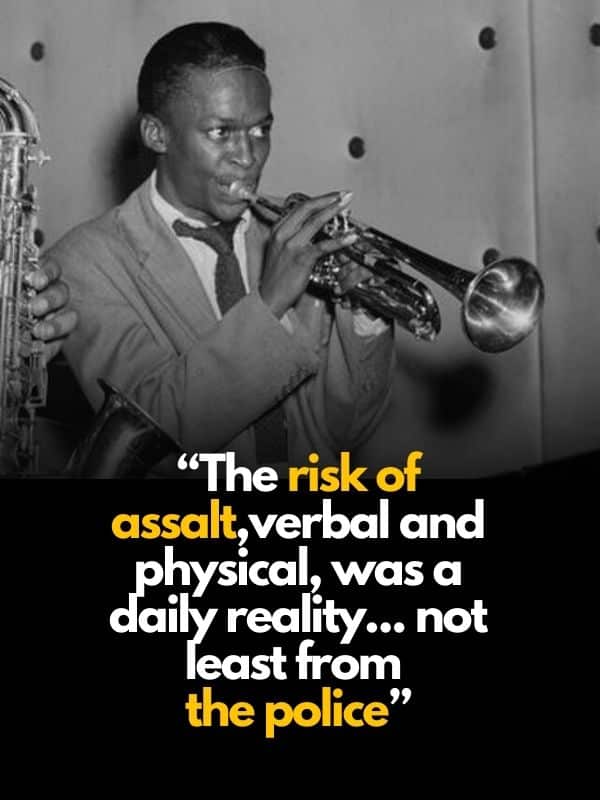
Miles pointed to the sign and explained that he was working inside the club. The officer repeated the order. A small crowd formed. At some point, a second officer arrived. Miles was struck from behind. He later wrote that he didn’t see the blow coming. The impact cut his head and blood ran down his suit.
Photographs taken at the police station show Miles bleeding while being processed.
The official charge was disorderly conduct and resisting arrest. The case went to trial, and he was acquitted in January 1960.
What Jimmy Cobb saw
One of the clearest first-hand accounts of that night comes from drummer Jimmy Cobb, who was working with Miles during that period. In the documentary The Miles Davis Story, Cobb states that the first officer “was drunk — you could smell the liquor on his breath.”
Cobb’s account is a personal memory from a musician who was on the bandstand that week. Contemporary press reports covered the assault, the injury and the later acquittal, but did not mention intoxication, so the detail lives through the musicians who experienced the moment rather than through the legal record, as you can see here.
A snapshot of the late 50s
The Birdland assault is often cited not because of its violence alone, but because of what it represents. Miles Davis was a globally recognised musician. He had just recorded a landmark jazz album. Yet he was still subject to the same risks and treatment that Black musicians faced every day in the United States.
In his autobiography, Miles reflected that he expected this kind of experience in his hometown, but not in New York, which he viewed as a centre of modern culture. The incident shaped his view of how success and vulnerability could coexist.
For many fans, knowing this context changes how Kind of Blue feels. The calm, the space, the control — they weren’t a sign of an easy life. They were musical choices made in a world that wasn’t calm at all.
Birdland in 1959
Birdland was not a neutral backdrop. It was one of the most important rooms in jazz. The list of artists who had played there reads like a history of the music: Charlie Parker, Dizzy Gillespie, Billie Holiday, Art Blakey, Count Basie and many others.
Being beaten under the club’s sign was symbolic. The stage represented artistic respect; the pavement represented the social reality outside it. Jazz in the late 1950s was entering a period of intense creativity, while the conditions for many of its key musicians remained unstable and discriminatory.
After Birdland
Miles continued working through the rest of 1959 and into the 1960s. In the years that followed, he developed new ideas with Gil Evans, led the second great quintet, and later explored electric and fusion sounds. The Birdland incident did not stop his progress, but it remained a notable moment in his story.
Jimmy Cobb stayed with the group until 1963. His drumming on Kind of Blue and later recordings remains an essential part of Miles’s sound from this era. Until his passing in 2020, he often spoke about the musicians he worked with and the circumstances around key moments in jazz.
Looking for more?
You can check out the full and highly-recommended documentary via the official Miles Davis website here.
You can also take a look at our pick of iconic Miles Davis albums here.