

For most musicians, being shot in the neck and losing the use of one arm would be career-ending. For guitarist Larry Carlton, it was the beginning of a long, difficult – but ultimately successful – process of rebuilding both his technique and his place in the music.
By the late 1980s, Larry Carlton had reached a level of professional security that very few musicians ever achieve.
He was one of the most respected guitarists in popular and jazz-influenced music. His sound was everywhere: on major studio recordings, on film scores, on fusion albums, and on some of the most carefully crafted pop records of the era.
For many listeners, his solo on Steely Dan’s “Kid Charlemagne” had already become a reference point for what tasteful, intelligent electric guitar could sound like.
He had built that position slowly.
Years of session work in Los Angeles had taught him how to serve songs. His solo career had given him an identity. Albums like Larry Carlton, Sleepwalk, and Alone/But Never Alone had established him as more than a sideman. By the late 1980s, Larry Carlton was not chasing relevance. He had it.
Then, in 1988, everything stopped.
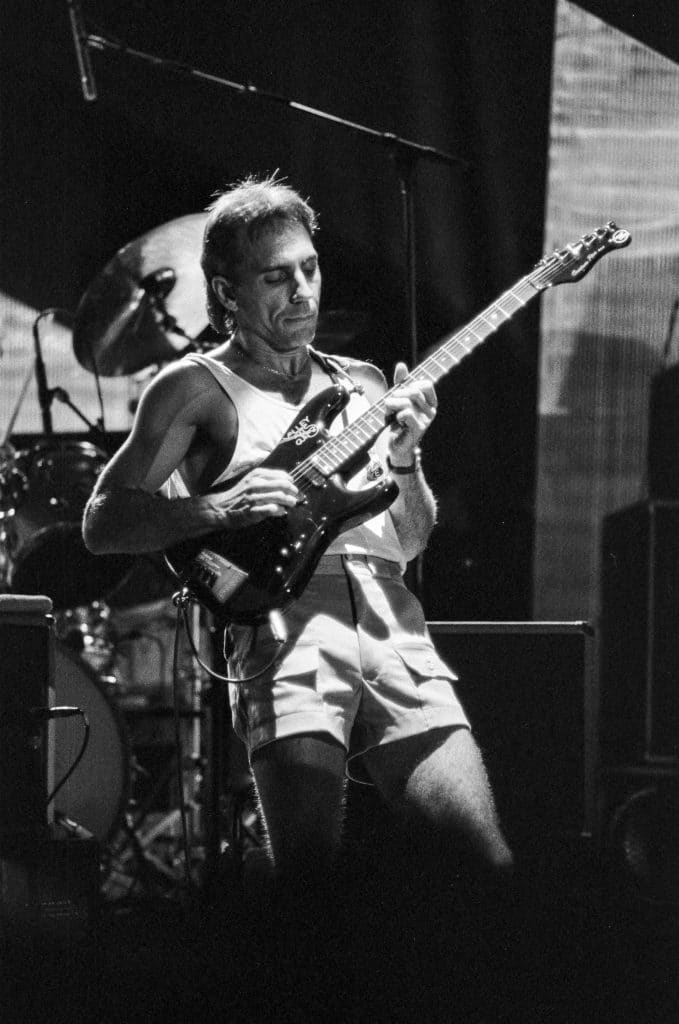
Room 335 and a Routine Night
Carlton’s home studio in Los Angeles was known as Room 335, named after the Gibson ES-335 guitar that had become inseparable from his sound. It was where he practised, recorded demos, worked on arrangements, and refined ideas.
On the night of 6th April 1988, he was working there, as he had done countless times before.
When he stepped outside, he was confronted by two unknown assailants and shot in the throat.
The circumstances were never fully clarified. There was no confirmed motive. The incident was widely described as a random act of violence. What was clear immediately was the severity of the injury.
The bullet caused serious nerve damage.
Carlton survived, but the consequences were devastating for a guitarist. His left arm — the fretting hand — was paralysed. Sensation and control were badly affected. For months, he could barely hold the instrument, let alone play it with precision.
For someone whose entire life had been built around touch, coordination, and subtle control, this was existential.
A Musician Without His Instrument
In an LA Times interview several weeks later, Carlton explained that while the shooting had left him “depressed” he was quietly optimistic about making a full comeback.
“All I can say is that I’m ahead of schedule. There’s no way to know whether it’ll be 9 months, 6 months, 12 months, 18 months. I’d like to think that it’s going to be as soon as is humanly possible.”
That sense of starting from nothing is not exaggeration.
After the surgery and initial recovery, his hand did not simply “come back”. Nerve damage does not heal neatly. It recovers slowly, unpredictably, and often incompletely. Fine motor control — the foundation of guitar playing — is especially vulnerable.
Carlton had to relearn movements that had once been automatic.
Basic scales became exercises in concentration. Chord shapes had to be rebuilt. Strength and independence in individual fingers had to be retrained. Even holding the neck comfortably took effort.
For months, he worked privately, away from public attention, rebuilding the connection between brain, nerve, and muscle.
There were no guarantees.
The Discipline of Recovery
What makes Carlton’s story remarkable is not that he recovered. It is how he approached recovery.
He did not treat it as a temporary setback. He treated it as a long-term technical project.
Those who know his background will recognise this pattern. His early years as a session musician had taught him patience and method. He had always been systematic about practice. After the shooting, that mindset became essential.
He worked with doctors and therapists, but he also designed his own musical rehabilitation. He practised slowly. He isolated movements. He focused on control rather than speed. He paid close attention to tone and touch.
Progress was measured in small increments.
A chord held cleanly. A scale played without tension. A phrase that sounded like it used to.
It took close to two years before he felt ready to perform again in public.
During that time, many musicians in his position would have disappeared quietly. The industry moves fast. Memory is short. Injuries end careers.
Carlton chose not to disappear.
Returning with On Solid Ground
When he finally returned with a new studio album in 1989, the title was not accidental.
On Solid Ground was a statement of intent.
It was not framed as a “comeback” record in a dramatic sense. There was no self-pity in the music. No overt narrative. But the underlying message was clear: he was back, and he was stable.
Musically, the album reflects that period of reconstruction.
The playing is controlled. The phrasing is deliberate. There is an emphasis on melody and structure. Nothing sounds rushed. Nothing sounds forced. The focus is on clarity.
If you listen closely, you can hear a guitarist who has thought carefully about every movement.
This is not diminished playing. It is concentrated playing.
For many listeners, it remains one of the most quietly impressive records in his catalogue.
Rebuilding a Career, Not Just Technique
Returning to form physically is one thing. Rebuilding momentum professionally is another.
Carlton had been absent from touring and high-profile recording for almost two years. In popular music terms, that is an eternity. Younger players were emerging. Styles were shifting. The industry was changing.
He did not attempt to chase those changes: he leaned into what he already did best.
He returned to touring gradually. He focused on projects that suited his musical priorities. He continued to record both as a leader and as a collaborator. Over the following years, he won multiple Grammy Awards and remained active internationally.
Albums such as Renegade Gentleman, Sapphire Blue, and later collaborations with Lee Ritenour kept him visible and respected.
More importantly, he retained credibility and kept himself top-of-mind with musicians, producers and audiences.
How the Injury Changed His Playing
Many long-time listeners have noticed subtle changes in Carlton’s playing after 1988.
The tone remained recognisable. The phrasing remained thoughtful. But there was often greater economy. More space. More emphasis on melodic shape than on extended runs.
Carlton learned how to work with a slightly altered instrument — his own body — and built a new equilibrium around it. He adjusted fingerings. He modified technique. He refined his approach to sustain and articulation.
In doing so, he became, if anything, more intentional as every note had to justify itself.
Perspective and Professionalism
One of the most striking aspects of Carlton’s story is how little bitterness surrounds it.
He rarely frames the shooting as a tragedy that derailed his destiny. He treats it as something that happened, something he had to deal with, and something he worked through.
For listeners who know the story, On Solid Ground carries obvious emotional weight of resilience and recovery.
But even without the backstory, it stands up as a serious musical statement.
Today, when people talk about Larry Carlton, they usually start with Steely Dan, Room 335, and his golden-era studio work.
But On Solid Ground belongs there as well — not as a footnote, but as proof of how solid that foundation really was.
Looking for more? Check out our guide to the greatest jazz guitarists of all time our our dive into these epic jazz fusion albums.