
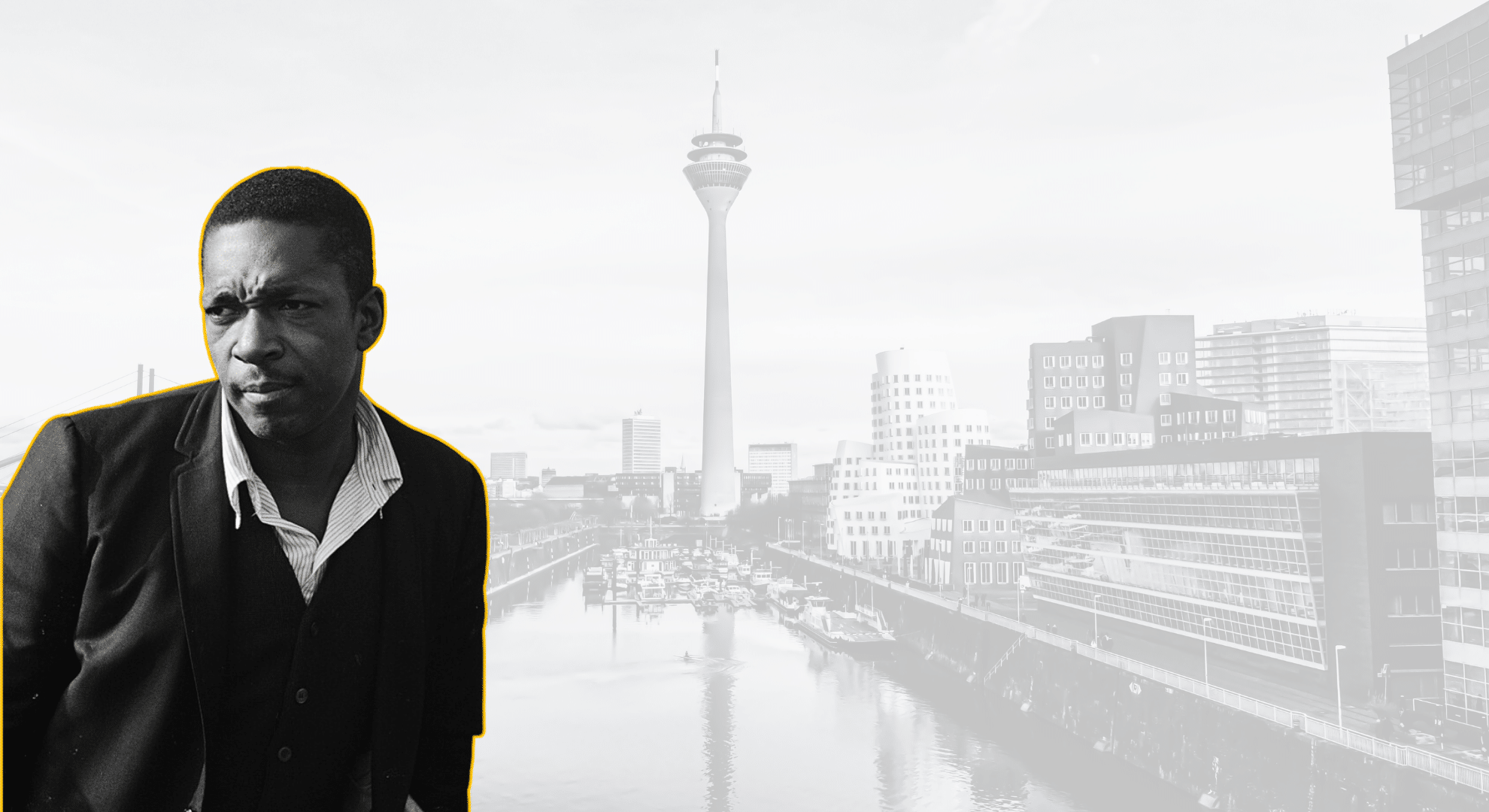
By 1960, John Coltrane had already established himself as one of the most powerful improvisers in modern jazz. Yet the direction his music would take over the following decade was only just beginning to emerge. Video footage captured in Düsseldorf, Germany documents one of the most important transitional periods in Coltrane’s career – you’ll find it below!
Only months earlier, he had left the group led by Miles Davis, where he had helped shape some of the defining recordings of the late 1950s. Albums such as Kind of Blue had already introduced a more modal approach to harmony, opening new possibilities for improvisation.
But Coltrane was now beginning to develop his own musical language at an even faster pace.
The Emerging Quartet
The Düsseldorf concert features an early version of the group that would soon become Coltrane’s most famous ensemble.
On piano is McCoy Tyner, whose powerful left-hand chords and modal harmonic approach would become central to the band’s sound. The rhythm section includes bassist Steve Davis and drummer Elvin Jones, whose rolling, polyrhythmic style transformed the way rhythm functioned in small-group jazz.
Within a short time, bassist Jimmy Garrison would replace Davis, completing the lineup that became known as the classic Coltrane quartet.
Together, that group would produce some of the most influential recordings in jazz history.
John Coltrane in Dusseldorf
In this performance, Coltrane kicks off with On Green Dolphin Street, a tune originally written for a 1947 film but widely adopted by musicians as a jazz standard during the 1950s.
By 1960 the piece had become a common vehicle for improvisation, appearing in the repertoires of many modern jazz groups.
Coltrane had already performed the tune while working with Miles Davis, but his interpretation here points toward the musical direction he would soon pursue more fully. The improvisation stretches across longer melodic lines, with intense harmonic exploration and a rhythmic freedom that would soon become hallmarks of his playing.
For listeners familiar with Coltrane’s later work, moments in performances like this can feel like early glimpses of the sound that would fully emerge in the early 1960s.
Jazz and European Television
The Düsseldorf footage also reflects another important aspect of jazz history during this period: the role of European broadcasters.
By the late 1950s and early 1960s, television networks in countries such as Germany, France, and the Netherlands were regularly recording visiting American jazz musicians. These broadcasts often preserved performances that might otherwise have disappeared.
As a result, many of the most valuable visual documents of modern jazz come from European television archives.
This Düsseldorf concert belongs to that tradition. It offers a rare extended look at Coltrane performing live during a moment when his musical ideas were evolving rapidly.
A Year of Transformation
The year 1960 sits at the centre of Coltrane’s transformation from an extraordinary improviser into one of the defining voices of modern jazz.
Only a year later he would record My Favorite Things, introducing his famous soprano saxophone sound and further exploring modal improvisation. Over the following years the quartet would push even further, eventually producing the landmark suite A Love Supreme.
Seen in that context, this Düsseldorf performance captures Coltrane during the moment when those developments were beginning to take shape.
The clip presents rare television footage of John Coltrane performing in Düsseldorf in 1960, offering a fascinating glimpse of a band that was still evolving — and of a musician who was about to reshape the direction of modern jazz.
Looking for more? Check out our article on some legendary John Coltrane albums here.