

Bill Evans’ time with Miles Davis was relatively brief, but it coincided with a period of intense musical output. In the space of less than a year, the group moved through a series of recordings that would later come to define a particular moment in jazz — even if, at the time, they were simply part of the band’s ongoing work.
When people think of Bill Evans’ time with Miles Davis, one recording tends to dominate the conversation: Kind of Blue. It has become shorthand for the entire collaboration — the defining statement, the moment where everything came together. But listening back to Evans’ own reflections in the video below, a more nuanced picture emerges, including a favourite recording they didn’t even know was being captured.
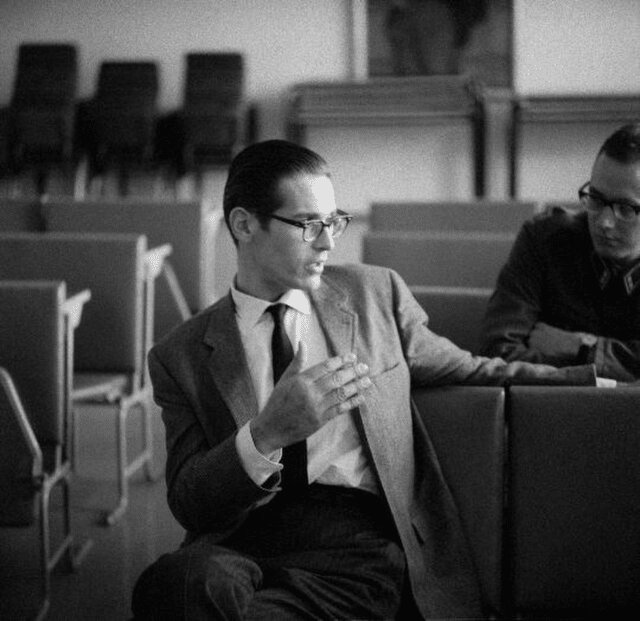
It is a story of a series of recordings, shaped by different line-ups, different contexts and, at times, moments that weren’t even meant to be documented at all.
What now feels historic often began as something much more ordinary: a working band, playing night after night, moving forward without much sense of how it would later be viewed.
A Working Band at a High Level
By the late 1950s, Evans had become part of a Miles Davis group that was recording regularly and performing at a consistently high level. In later interviews, he refers to sessions that produced versions of On Green Dolphin Street, Stella by Starlight and Love for Sale — recordings that are now often grouped together as part of a classic period in Davis’ output.
What stands out is how he describes them. There is no sense that these were treated as landmark sessions at the time. They were part of the normal rhythm of a working band. Musicians came in, played the material, and delivered what was required of them. The focus was on doing the job well, not on creating something that would later be held up as definitive.
That perspective shifts how we hear those recordings now, placing them back into the day-to-day reality they came from.
Kind of Blue: Chemistry Over Design
Even when the conversation turns to Kind of Blue, Evans avoids framing it as something carefully constructed or inevitable. The session itself has often been noted for how quickly it came together, with minimal rehearsal and a relatively open musical framework. But for Evans, that isn’t the most important point.
What mattered was the chemistry between the musicians. Everyone involved was already operating at a high level, capable of producing strong results in almost any setting. What happened on that particular session, he suggests, is that everything aligned slightly more than usual.
It’s a subtle distinction, but an important one. Rather than presenting the album as the result of a grand design, Evans points to something far less controllable — the rare moment when preparation and interaction combine in a way that cannot be repeated on demand.
The Recording That Wasn’t Meant to Exist
Alongside those well-known studio sessions, Evans highlights a very different kind of recording. It was a live performance that the band did not even realise was being captured at the time. Later released as Jazz at the Plaza, it documents the group in a setting that sits outside the controlled environment of a studio session.
There was no sense of working towards a finished product, no pressure to produce a definitive take. The performance unfolded as part of a normal engagement, shaped only by the interaction of the musicians in the moment.
For Evans, that is precisely what makes it valuable. It captures something less filtered, offering a glimpse of how the band actually sounded without the constraints that come with recording.
Watch Evans describe this period in the interview below:
A Different Version of the Band
One of the key differences Evans points to in that earlier recording is the presence of drummer Philly Joe Jones. By the time of Kind of Blue and other later sessions, Jimmy Cobb had taken over the role. That change does more than alter the personnel list. It affects the feel of the music at a fundamental level.
The time, the energy and the interaction within the rhythm section all shift accordingly. As a result, these recordings do not simply document different performances of similar material.
They reveal different versions of the band itself, each with its own character. In that sense, the live recording becomes more than a curiosity. It offers a way of hearing how the group functioned before that transition took place.
What the Studio Leaves Out
Recording in a studio, particularly in that era, came with its own set of limitations. Time was restricted, budgets mattered, and musicians were expected to produce complete takes within relatively narrow windows. Those constraints inevitably shape the outcome, even when the results are exceptional.
A live recording, especially one made without the musicians’ awareness, operates under different conditions. There is no expectation of finality, no need to capture a definitive version of a piece. The music unfolds more freely, guided only by the internal dynamics of the group. That does not necessarily make it better, but it can make it more revealing, offering a perspective that studio recordings do not always provide.
Key Recordings: Bill Evans with Miles Davis
Bill Evans’ recorded work with Miles Davis spans only a small number of sessions, but they capture the collaboration at several distinct moments — from transitional studio appearances to one of the most influential albums in jazz, alongside a live recording the band didn’t even realise was being documented.
- Milestones (1958) — Evans appears on “Sid’s Ahead”, marking a brief early contribution within a changing line-up
- Jazz at the Plaza (1958, released later) — live recording featuring the band with Philly Joe Jones, captured without their knowledge
- Kind of Blue (1959) — Evans plays on most of the album, shaping its harmonic direction and overall sound
- Someday My Prince Will Come (1961) — Evans returns as a guest pianist on selected tracks
Taken together, these recordings offer a concise but revealing view of the collaboration, showing a band evolving across different settings rather than working towards a single fixed outcome.
Revisiting the Recordings
Evans also reflects on the experience of listening back to his earlier recordings, something he avoided for many years. With distance, he found he could hear them more objectively — not as personal statements, but as material to learn from. He noticed differences in his playing, approaches he no longer used, and ideas that had evolved over time.
That same perspective applies to his work with Miles Davis. The most famous recordings remain essential, but they are only part of the story. The lesser-known sessions, including those that were never intended for release, can offer a different way into the music. They reveal details that are easy to miss when attention is focused only on the established landmarks.
Key Takeaway
Evans’ reflections strip away some of the mythology that has built up around this period. What remains is a simpler and more practical picture: a working band, shifting line-ups, and moments where everything came together slightly more than usual. Alongside those are recordings that capture something less planned, but no less important — documents of the music as it actually happened.