

If you have ever found yourself tapping your foot to a classic jazz recording without quite knowing why it feels so good, there is a strong chance that Jimmy Cobb was sitting behind the drum kit.
Across more than sixty years of recording, Cobb appeared on some of the most influential albums in jazz history, often in situations where the music depended less on dramatic gestures than on balance, control, and trust. He was one of those jazz drummers who didn’t demand attention, but who made everything else work.
Of course there’s Kind of Blue, but also countless other albums which show how musical authority can be exercised through restraint rather than force. We’ve picked some of the best ones (in our opinion!) here…
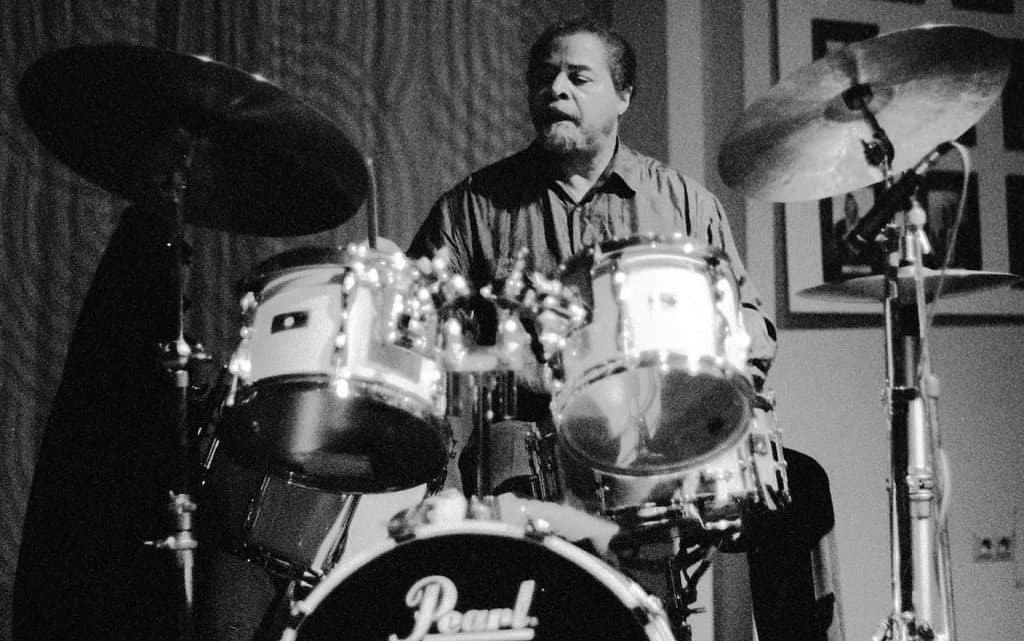
Early Years: Washington, D.C., and Professional Foundations
Born in 1929 in Washington, D.C., Cobb grew up in a city with a strong jazz culture and close links to the touring circuit. He began playing professionally while still young, absorbing swing traditions before bebop became dominant.
By the early 1950s, he was working regularly with musicians such as Earl Bostic and Dinah Washington, experiences that sharpened his sense of accompaniment.
These jobs demanded reliability. Supporting vocalists and popular instrumentalists required precise time, flexible dynamics, and the ability to adapt instantly to different musical personalities.
Cobb learned early that a drummer’s primary responsibility was not self-expression but musical stability.
That principle never left him.
Breakthrough: Joining the Miles Davis Sextet
Cobb’s career changed decisively in 1958, when he joined the band of Miles Davis.
This group—featuring John Coltrane, Cannonball Adderley, Bill Evans, and Paul Chambers—would record one of the most important albums in the history of recorded music.
That album was Kind of Blue.
Kind of Blue and the Sound of Balance
It is difficult to overstate Cobb’s contribution to Kind of Blue.
The album’s success rests on atmosphere, pacing, and internal balance as much as on melody or harmony. Cobb provides all three.
His ride cymbal establishes a relaxed but unwavering pulse. His snare and bass drum are used sparingly, placed for structural emphasis rather than decoration. Fills are rare, and when they appear, they are short and proportionate.
On “So What” and “Freddie Freeloader,” he maintains forward motion without urgency. On “Blue in Green,” he plays with extreme sensitivity to dynamics and phrasing.
Nothing sounds imposed.
The drummer’s role here is architectural rather than expressive in the conventional sense. Cobb constructs a stable rhythmic environment in which modal improvisation can unfold naturally.
Few drummers have ever demonstrated this level of situational awareness on such a high-profile recording.
Beyond Kind of Blue: The Miles Years
Cobb remained with Davis until 1963, appearing on several major albums, including Someday My Prince Will Come and Sketches of Spain.
These recordings demanded different kinds of discipline.
Sketches of Spain required sensitivity to orchestral textures and extended forms. Someday My Prince Will Come involved supporting shifting line-ups and stylistic approaches.
Across these projects, Cobb demonstrated remarkable adaptability. He adjusted touch, volume, and rhythmic emphasis to suit each context without losing his underlying identity.
His drumming during this period represents a masterclass in musical flexibility.
Sideman Excellence: Building a Legendary Discography
After leaving Davis’s band, Cobb became one of the most in-demand drummers in jazz.
He recorded extensively with:
- Wes Montgomery
- Stan Getz
- Julian Cannonball Adderley
- George Benson
His work with Montgomery, in particular, stands out. Albums such as The Incredible Jazz Guitar of Wes Montgomery benefit from Cobb’s ability to support complex harmonic movement without clutter.
Montgomery’s phrasing requires space. Cobb provides it.
Similarly, on Stan Getz sessions, he adapts to lighter textures and more floating time feels, reinforcing melodic flow rather than rhythmic weight.
Over time, his discography became a catalogue of trust.
When producers wanted sessions to feel stable, elegant, and professional, Cobb was often the first call.
Leadership and Late-Career Projects
Although best known as a sideman, Cobb also recorded as a leader, particularly later in life.
One of his most important leadership projects is Jazz in the Key of Blue, recorded to mark the fiftieth anniversary of Kind of Blue.
Featuring Russell Malone and Roy Hargrove, the album revisits the Davis repertoire with contemporary musicians.
Rather than attempting to recreate the original, Cobb frames the material in a modern context, allowing space for reinterpretation.
His drumming remains centred on balance and proportion, demonstrating that his core approach had not weakened with age.
Technique, Touch, and Time Feel
Cobb’s technical approach was based on economy.
He favoured a relatively high ride cymbal pattern with consistent articulation. His snare work was precise and lightly voiced. Bass drum usage was minimal, often reserved for structural punctuation.
This restraint produced a transparent rhythmic texture.
More importantly, his time feel was exceptionally stable. He placed beats with subtle forward motion, creating momentum without rushing. This quality made him particularly effective in modal and ballad settings.
Many drummers focus on subdivision.
Cobb focused on placement.
Musical Relationships and Listening
One of Cobb’s defining traits was his ability to listen.
He adjusted constantly to soloists’ phrasing, harmonic rhythm, and dynamic range. Rather than asserting a fixed groove, he reshaped patterns in response to musical developments.
This responsiveness is especially clear in small-group recordings, where shifts in intensity happen organically rather than through explicit cues.
His drumming reflects conversation rather than command.
Navigating the Discography
Because Cobb appeared on so many major albums, listeners often encounter him before they know his name.
A useful way to explore his work might include:
- Kind of Blue for modal mastery
- The Incredible Jazz Guitar of Wes Montgomery for small-group balance
- Someday My Prince Will Come for adaptability
- Jazz in the Key of Blue for late-career leadership
These recordings highlight different aspects of his contribution.
Professionalism and Musical Ethics
Cobb’s reputation was built as much on conduct as on musicianship.
He arrived prepared. He respected leaders’ visions. He avoided unnecessary conflict. He supported younger musicians. He maintained consistency across changing circumstances.
This professionalism shaped his artistic choices. He preferred musical environments that valued listening and cooperation over competition.
As a result, his discography reflects continuity rather than volatility.
Listening to Jimmy Cobb Over Time
Jimmy Cobb’s albums do not tell a story of radical reinvention.
They tell a story of sustained musical intelligence.
Across modal jazz, hard bop, orchestral projects, and late-career small groups, he maintained an approach based on proportion, awareness, and trust in collective sound. His decisions about touch, tempo, and placement shaped the character of hundreds of recordings.
Even in his final years, he continued refining balance and pacing rather than relying on reputation.
For listeners interested in how great jazz records are made from the inside out, his work offers one of the clearest long-term examples available.