

The trumpet mouthpiece may be small, but it can play a massive role in helping you achieve the sound that you want to achieve when playing jazz.
In this article we’re going to take a trip through the history of trumpet mouthpieces and recommend some leading brands to try.
The trumpet mouthpiece is often the first thing you’re given when you start to learn to play. Sometimes the only thing!
As such, choosing the best trumpet mouthpiece for you is an important decision, and one which needs to balance comfort with quality of sound.
We’ll take a look at some of the basics of mouthpiece design and then recommend some of the top brands, as well as the great jazz trumpeters who used them.
In case you’re in a rush, here’s our round up of 5 of the best jazz trumpet mouthpieces for each situation…
| Image | Product | Features | Price |
|---|---|---|---|
#1 Recommended  |
| Check Price on Amazon | |
Premium Option 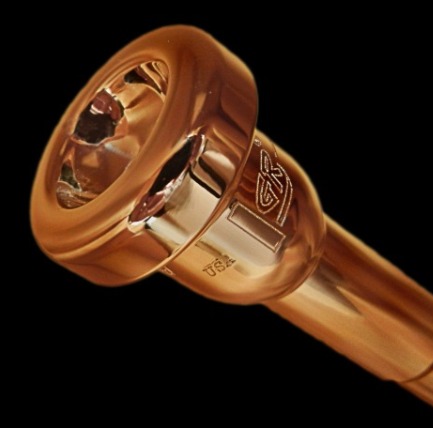 |
| Check Price | |
Budget Option 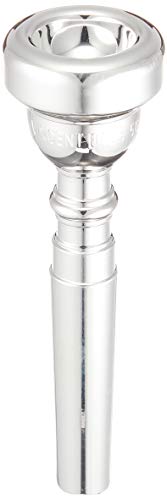 |
| Check Price on Amazon |
About the Trumpet Mouthpiece
The trumpet mouthpiece is a bit like the interface between the trumpet and the body, and it can have a huge effect on your sound, efficiency and consistency.
The main variables in a trumpet mouthpiece are:
The rim
This is where the mouthpiece touches your face! As such, it’s important that it feels comfortable to you, personally.
When talking about mouthpiece rims, we’d generally describe them as either ‘flat’ or ’rounded’ – with every shade in between.
In general, the flatter rims offer more comfort (at the expense of some flexibility) so they are the more common choice for new students.
The cup
This is the resonating chamber of the mouthpiece and determines how much of the lip will be able to vibrate.
As such, its diameter is an important factor in sound production; a shallow cup generally allows for more control and a brighter tone, whilst a deep cup will produce a darker tone.
Traditionally trumpeters have used big cup for classical and orchestral playing and small cups for jazz or commercial playing – but there are of course exceptions to the rule.
In general, a shallower cup also requires less effort from the player and, as such, is the more common choice for beginner trumpeters.
The throat
This is the width of the opening at the bottom of the cup and, as such, controls how air will pass through.
Because of this, it can have a massive effect on sound production, with a larger throat helping with a big, open sound, whilst a smaller throat creates more pressure and helps support those high notes!
The backbore
The backbore is the part of the trumpet mouthpiece where the throat begins to widen.
It effects how the air moves from the mouthpiece into the instrument and it’s shape can have a big effect on tone production.
Different trumpet mouthpiece brands have different terminology, but essentially an open backbore helps in the lower range whilst a smaller, tight backbore provides more resistance to support the upper harmonics.
How to choose a trumpet mouthpiece for jazz
Most beginner trumpeters play the mouthpiece they are given, or that comes with their instrument, until they or their teacher decides they’ve ‘outgrown’ it.
If you’re a beginner, choosing a classic mouthpiece with an ‘all round’ sound is a safe place to start.
After that, it’s a case of figuring out which mouthpiece is right for you, personally.
This can involve a mixture of research – looking at the set ups of your favourite players – and trying out different mouthpieces to see how they feel.
Think of it like a pair of running shoes: copying the brand and size of running shoe Usain Bolt uses will probably ensure you are buying a quality sprinting shoe, but it doesn’t mean they will be a great fit and make you as fast as him!
When looking for mouthpieces you need to find one that fits your face/teeth structure to make sure that no out-of-line teeth are digging into your lip.
When testing out a new mouthpiece for playing jazz, it’s important to play a variety of tunes and fundamental exercises.
Start playing softly and in the middle register, then increase the volume bit by bit, try different articulations and styles, and see if you are drawn towards a certain way of playing on that mouthpiece.
Of course, do you research about cup depths and backbores, but don’t let that influence your decision: think about the sound you want to make and whether this mouthpiece helps achieve that.
“For me, as soon as I find one that just makes me want to play and gets me excited about expressing myself, that’s usually a good sign that it’s making the right sound and I’m not aware of any discomfort. Then I take it on a gig and try it, because it can all change once you get on the band stand!” – Freddie Gavita, British jazz trumpeter
The best jazz trumpet mouthpieces (and who played them!)
Trumpet players love to talk about mouthpieces and other trumpeters!
It therefore comes as no shock that when we hear somebody playing amazing jazz trumpet, we want to find out what gear they’re using, buy it, and hope that we now sound like that person.
Whilst it’s of course not as simple as that, finding out which of your favourite players uses which mouthpiece and horn is a good start in achieving the sound you want.
If you look through the 100 year history of jazz trumpet, you can spot some interesting trends and a slow shift from smaller equipment with more resistance to large gear with less.
One theory is that the development of live sound engineering, microphones and recording equipment has changed things; that brighter sound that carries over the rest of the band is less important now than in years gone by.
Nowadays we see jazz players burying the bell into a microphone to get a warm, smokey sound; a bigger mouthpiece generally gets you a darker sound.
Trumpet players are notorious for chopping and changing, but interestingly it seems that the jazz players of the swing and bop eras seemed to stick with their mouthpiece and change the horn instead.
Whilst most trumpet mouthpieces come in a range of sizes, the overall brands tend to have their own specific characteristics. That’s what makes these next trumpet mouthpiece makers the recognisable and sought-after pieces of equipment they are!
Vincent Bach mouthpieces
Different eras in jazz may have called for changes in playing styles, but one brand has stayed throughout!
Vincent Bach is one of the great brass innovators, producing industry standard trumpets and mouthpieces since the early 20th Century.
Vincent Bach mouthpiece have been used by pretty much every famous jazz trumpeter at some point in their career including, to name just a few:
- Clifford Brown (Bach 10-3/4C)
- Woody Shaw (Bach 7C)
- Freddie Hubbard/Chet Baker (Bach 6)
- Kenny Wheeler & Arturo Sandoval (Bach 3C)
- Wynton Marsalis (Bach 1-1/4C)
As you can see, there are a lot of different players with very different sounds, all playing on Bach mouthpieces. As such, they are more of a high quality blank canvas compared to others which have a strongly recognisable effect on your sound.
Best all-round jazz trumpet mouthpiece – the Bach 3C
You’d be hard pressed to find a better all round mouthpiece than the Bach 3C – it’s probably the most common size and is used by players in a wide variety of styles, so if you want one mouthpiece that you can play New Orleans, big band, be-bop, contemporary music and more, this is the one.
It’s also available as a ‘Megatone’ model, with more mass added, which can make the trumpet slots feel a little more secure.
| Image | Product | Features | Price |
|---|---|---|---|
|
| Check Price on Amazon |
Best for beginners – the 5C
Bach mouthpieces are great value and often work well – in sizes like a 5c, 6c or 7c – as a beginner trumpet mouthpiece. They’ll allow you to create the sound you want, rather than the sound the mouthpiece wants you to have!
| Image | Product | Features | Price |
|---|---|---|---|
|
| Check Price on Amazon |
Anecdotally, Vincent Bach mouthpieces have some limitations with tuning and consistency compared to some of today’s high-tech CNC produced mouthpieces but they are a great, comfortable, proven option.
Heim mouthpieces
In the mid 50s, Miles Davis (probably one of the only jazz trumpeters we haven’t seen use a Bach!) moved onto his Heim mouthpiece.
It had a narrow rim with a deep V cup that helped him create the super dark trumpet sound he’s known for.
Many Miles Davis devotees, including Wallace Roney and Enrico Rava, played these too, and they really do help to get that sound.
On the negative side, these mouthpieces are hard to find, and are often in poor condition these days.
If your goal is to get that dark Miles Davis sound on your trumpet, your best bet is to look for alternative mouthpieces with that deep V-shaped cup.
Heim alternatives
The Kanstul – which is still manufactured today – was designed for Miles a bit later on in his career.
Any trumpet mouthpiece you can find with a more flugel/cornet style V cup will help you get closer; the Bach 7 is a good example of this!
Monette Mouthpieces
The emergence of Dave Monette’s brand in the mid 80s was a game changer for jazz trumpet playing.
No one had marketed a mouthpiece like this before, and getting the world class Wynton Marsalis on side was a masterstroke!
Wynton was the first of many to switch from a Bach mouthpiece to a Monette, followed by 1990s rising jazz trumpet stars such as such Ingrid Jenson, Ryan Kisor, Roy Hargrove, Nicholas Payton and Jeremy Pelt.
Monette mouthpieces have large throats that keep your sound full. They can take a lot of air, but require a lot of support and an efficient technique to get the most out of them.
The rims are very comfortable, they have a variety of cup depths available, and are favoured by a lot of contemporary jazz players as they allow the sound to be bent and moved all over the place.
Unless you already play a Monette trumpet, we’d suggest choosing the STC-1 weight seriesand either the B6 (close to a Bach 3C) or B2 (close to a Bach 1C).
The new “Resonance” models are a big step forward, but at a much higher price than a Bach, perhaps not the most accessible to the up and coming player. If you’re an advanced trumpet player, this one has got to be tried!
If you start listening, you’ll always be able to tell when someone is playing a Monette. Usually they have it because they want to sound like Wynton!
Al Cass
During the 30s and 40s, Al Cass mouthpieces were all the rage.
You can hear Harry ‘Sweets’ Edison, Roy Eldrige, Dizzy Gillespie, Howard McGhee, Red Rodney and Blue Mitchell all playing on these, and the characteristics are there to hear!
You get a bright, exciting sound with a really aggressive attack from these mouthpieces, and they clearly help you get heard over a big band!
They don’t necessarily help you play higher than you already can, but they can help reinforce your current range.
With shallow mouthpieces you need to make sure you let the extra resistance do some of the work for you, so if you’re trying something like this out, make sure you try not to blow as hard as you normally do!
These mouthpieces are similar to the Heim as they are not really played much anymore.
Marcinkiewicz
For a reasonable price, you can get similar characteristics from the Marcinkiewicz brand, particularly the Bobby Shew model.
The Shew seems to be universally quite comfortable and goes against the rule of just buying a mouthpiece because it was developed by a certain player!
Giardinelli
Another manufacturer popular with jazz and commercial players from the 20th Century is Giardinelli…and these are still available!
Played by real trumpet heroes such as Derek Watkins, Tony Fisher, Bill Chase, and Maynard Ferguson, they are popular with the more commercial end of the jazz spectrum, and were also used by some guy called Louis Armstrong.
Final words: Your next jazz trumpet mouthpiece
Using the sounds of your favourite jazz trumpet players is useful as a guide for equipment, but ultimately it’s down to you to choose one that’s comfortable and allows you to make the sound you want to make.
The good news is that there’s a huge range of great mouthpieces out there, for every possible style you could want.
Mouthpiece making has improved dramatically over the last 30 years, with some big names hitting the market and staying there.
Manufacturers like Monette, Gary Radke, Antonio Rapacciulo, Harrelson and Austin Custom Brass have come in with great innovations such as computer guided cutting tools, constant pitch centre, adjustable mouthpieces and complex series of play tests to help you choose the right one!
And, alongside that, there are still legendary vintage brands producing excellent mouthpieces in 2025.
We hope this guide has been useful and feel free to post any questions below.
Looking for more? Check out our complete guide to the different types of trumpet here.

I have been using the seldom mentioned Stork Vacchiano 1.5e. The e bowl is a little shallow but deeper than a Bach e, so that my lips do not bottom out on the bottom of the bowl. I think the bowl is slightly conical, not certain though. It has a mildly bright sound.
Chet Baker played a Bach 6B and 6C. Lee Morgan also played a 6C.
The Bach 5C is very different from the 1C/3C/7C family. I started out on a 5C and years later tried the 1C, 7C, and 3C, and found that the 5C was limiting my ability to play high notes and was harder to play all around. I would not recommend a 5C for beginners at all. There is a reason that beginner trumpets almost all come with a Bach 7C or third party clone of the 7C.
I play on a Bach 3C and do not get jazz sound from it at all.