

Billy Strayhorn wrote “Take the ‘A’ Train” in 1939, a few months into a job with Duke Ellington that had no fixed title. The tune then sat unused for two years. Over the next 28 years he wrote a substantial part of the Ellington book — and for much of that time his name wasn’t on it.
Some pieces went out under Ellington’s name. Others were registered as joint compositions when the manuscripts point to one author. What follows are ten where Strayhorn’s authorship is documented, in rough chronological order, with the recordings worth starting from.
1. Something to Live For (1939)
The first Billy Strayhorn composition the Ellington orchestra ever recorded, and the piece that got him the job.
Strayhorn had begun working on it as a teenager in Pittsburgh, developing it from an earlier lyric of his own. When he met Ellington backstage in Pittsburgh in December 1938, this was one of the songs he played and sang for him. The band recorded it on 21 March 1939 at the World Broadcasting System studios on Fifth Avenue, with Jean Eldridge singing. According to the Mosaic discography of the Brunswick and Columbia masters, Strayhorn himself is at the piano on that take rather than Ellington — which, on his first significant date with the band, tells you something about how quickly Ellington had decided about him.
The song is credited to both men. It is almost certainly Strayhorn’s alone — and that pattern is the reason a list like this is harder to assemble than it looks. The musicologist Walter van de Leur spent years working through the surviving scores, which can be sorted by hand: Ellington and Strayhorn wrote in distinctly different ways on paper. What emerged was a body of work considerably larger than the credits suggest, and it underpins most of what follows here.
Start with: the 1939 Eldridge recording, then Ella Fitzgerald and Ellington’s 1965 version for contrast.
2. Day Dream (1939)
In March 1939 the Ellington band sailed for Europe. Strayhorn, newly hired, stayed behind in Harlem — which gave him roughly seven uninterrupted weeks to write. “Day Dream” came out of that gap.
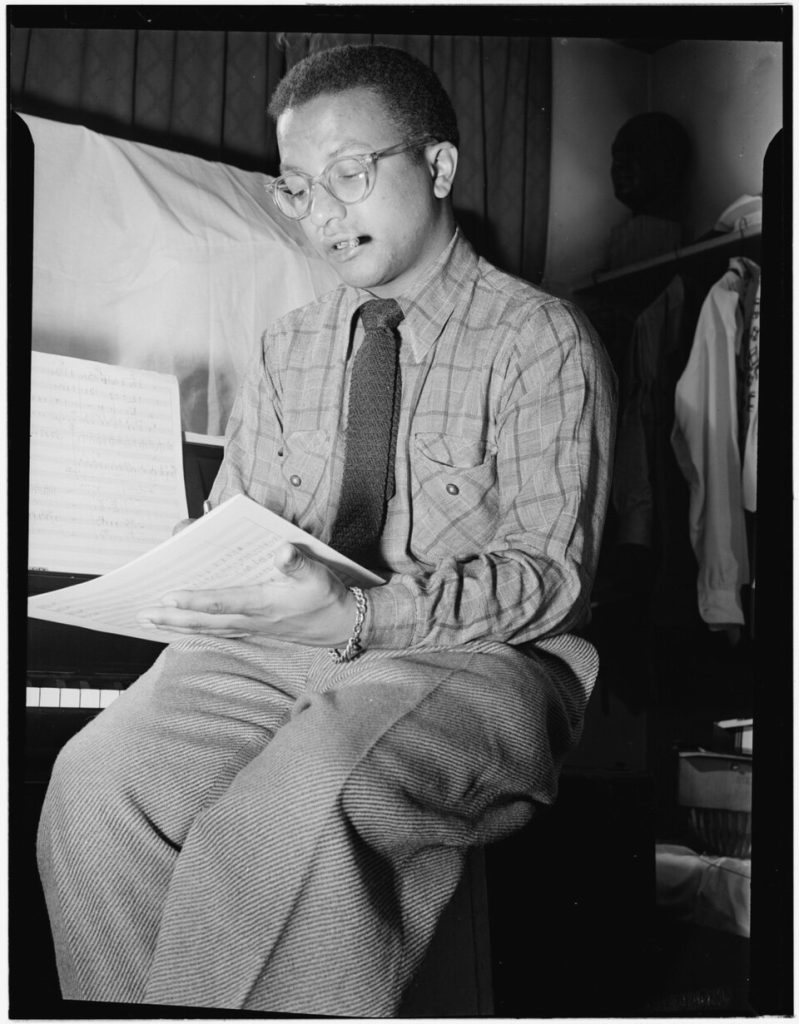
It was first recorded not by Ellington but by a Johnny Hodges small group drawn from the band, on 2 November 1940. Ellington was credited as co-composer on the original 78 label; he is not generally considered to have written any of it. John Latouche later added the lyric.
Start with: the 1940 Hodges recording. The tune has since become a vocal standard, but Hodges plays it as if the melody were an alto part all along.
3. Take the “A” Train (1939)
Strayhorn wrote it in 1939 and it then sat unused for two years.
What rescued it was a licensing dispute. When ASCAP raised its broadcast fees in 1940, radio stations stopped playing ASCAP-registered material — which meant the Ellington band could not broadcast its own book. Ellington turned to the two people around him registered with the rival body BMI: his son Mercer, and Strayhorn. They were asked to write a replacement repertoire, effectively overnight.
“A” Train was recorded on 15 January 1941 as a radio transcription and commercially on 15 February 1941 for Victor. It replaced “Sepia Panorama” as the band’s signature tune and stayed there. The recording is also Ray Nance’s first commercial appearance with the orchestra — he had joined the previous November, replacing Cootie Williams — and his two-chorus solo became so fixed in the arrangement that later trumpeters played it more or less verbatim.
The often-repeated story that Mercer retrieved the manuscript from a bin, discarded because Strayhorn thought it sounded too much like Fletcher Henderson, comes from Mercer himself and is treated by several Ellington researchers as apocryphal. It may well be true. It is not established.
Start with: the 15 February 1941 Victor recording.
4. Chelsea Bridge (1941)
Written during the same BMI scramble, and about as far from a functional radio-replacement tune as it is possible to get.
“Chelsea Bridge” is built on floating minor-major seventh harmony and owes an obvious debt to Debussy. Gunther Schuller wrote about the chromatic ambiguity of the theme; Gil Evans said flatly that hearing it set the direction of his own writing. The Ellington orchestra recorded it for Victor on 2 December 1941, with Strayhorn at the piano rather than Ellington, and solos from Ben Webster and Juan Tizol. It had already been played on the bandstand — it turns up in a Casa Manana dance broadcast from February 1941.
The title has a small mystery attached. The Ellington biographer James Lincoln Collier suggested Strayhorn was inspired by a Turner or Whistler painting of Battersea Bridge and named the piece after the wrong crossing. Strayhorn’s partner Aaron Bridgers, interviewed decades later, said Strayhorn knew perfectly well the painting showed Battersea and simply preferred the sound of “Chelsea Bridge”. Both accounts are in circulation; the second comes from someone who was there.
Start with: the 1941 Ellington recording, then Ben Webster’s later versions under his own name.
5. Passion Flower (1941)
A Johnny Hodges feature and one of the most concentrated things Strayhorn wrote in this period — slow, harmonically dense, and almost entirely surrendered to the soloist.
Hodges recorded it in 1941 with a small group drawn from the Ellington band. The partnership between the two men lasted the rest of Strayhorn’s life; Hodges made whole albums of his writing, and it was Hodges who played the alto part on almost every major Strayhorn ballad from here on.
Start with: the Hodges small-group recording.
6. Lush Life (published 1949)
Strayhorn started it in Pittsburgh in the early 1930s, in his teens, and finished it around 1936. Then he kept it to himself for over a decade.
He played it at parties. Friends and industry people who heard it told him to record it. He didn’t. According to David Hajdu’s biography, Strayhorn regarded it as a private piece. It was performed in public for the first time on 13 November 1948, at Ellington’s fifth annual Carnegie Hall concert, sung by Kay Davis with Strayhorn accompanying. Ellington introduced it from the stage as a new tune. It had been fifteen years old.
Nat King Cole recorded it for Capitol on 29 March 1949 with an arrangement by Pete Rugolo, and that recording is what turned it into a standard. Strayhorn, who had not been consulted, was reportedly furious about the alterations — while collecting substantial royalties from it. It was copyrighted the same year by Ellington’s publishing company, Tempo Music.
Start with: Cole’s 1949 Capitol recording, then John Coltrane and Johnny Hartman from 1963.
7. U.M.M.G. (1956)
Short for Upper Manhattan Medical Group — the Harlem practice co-founded by Dr Arthur Logan, physician and close friend to both Ellington and Strayhorn. The title is a dedication disguised as an acronym.
Musically it is Strayhorn absorbing bebop: fast, rhythmically slippery, harmonically restless. The chart was written to feature Jimmy Hamilton on clarinet, Willie Cook on trumpet (later Clark Terry) and Harry Carney on baritone. Ellington first recorded it in 1956 at sessions for Bethlehem, but the version most people know is from Ellington Jazz Party (Columbia, 1959), where Dizzy Gillespie sat in as the main soloist — with Dr Logan present in the studio.
Start with: the 1959 Columbia recording with Gillespie.
8. The Star-Crossed Lovers (1957)
Such Sweet Thunder, the Ellington–Strayhorn Shakespeare suite, was written in under three weeks while Ellington was simultaneously preparing a live television broadcast of A Drum Is a Woman. Under that pressure, Ellington asked Strayhorn to repurpose two existing pieces.
A ballad titled “Lately” became “Half the Fun”, recast as Cleopatra on her barge. A Hodges feature titled “Pretty Girl” became the Romeo and Juliet movement, “The Star-Crossed Lovers”. The suite was recorded across sessions in spring 1957, this piece on 3 May.
The renaming was expedient. It also happens to fit, which is the part worth noticing.
Start with: Such Sweet Thunder (Columbia, 1957). The expanded CD includes takes from when it was still “Pretty Girl”.
9. Isfahan (1966)
The best-known piece on The Far East Suite was not written about the Far East.
Strayhorn composed it in 1963 under the title “Elf”, and it was first recorded in New York on 18 July that year — months before the State Department tour that took the Ellington band to Iran, India, Syria, Jordan, Lebanon, Turkey, Pakistan and Ceylon. By the time the band played it on the BBC’s Jazz 625 in February 1964 it had been retitled. It was recorded for the suite on 20 December 1966, as a feature for Hodges.
The Ellington band never played the arrangement again after that session. The tune has since been recorded well over two hundred times.
Start with: The Far East Suite (RCA, 1967).
10. Blood Count (1967)
Strayhorn was diagnosed with oesophageal cancer in 1964. In early 1967, in hospital and on a liquid diet, he was working on a multi-movement piece for Ellington. One section existed in his hand under the title “Blue Cloud”.
He appears to have realised he would not finish the larger work. In February 1967 he sent the score to Ellington to have parts extracted, retitled “Blood Count” — a title that is his own; a lead sheet survives in his handwriting.
Ellington rehearsed it on tour in Italy and premiered it in Stuttgart on 6 March 1967, then played it in Paris on 10 March and at Carnegie Hall on 26 March. (The frequently repeated claim that it premiered at Carnegie Hall is wrong.) Strayhorn died on 31 May 1967. The band recorded it on 28 August for …And His Mother Called Him Bill, with Hodges on alto. It was the last thing Strayhorn completed.
Start with: …And His Mother Called Him Bill (RCA, 1967).
And one more: Lotus Blossom
Ellington recorded the Strayhorn tribute album in August and November 1967, choosing pieces — several never previously recorded — to show the range of what his writing partner could do.
At the end of one session, with the band packing up around him and the tape still rolling, Ellington sat down at the piano and played “Lotus Blossom”. You can hear the room in the background. He said afterwards that it was the piece Strayhorn most liked to hear him play. The producer, Brad McCuen, persuaded him to include the take, and it closes the album.
Ellington kept playing it in concert for the rest of his life.
Where to go next
For the biography, David Hajdu’s Lush Life (1996) remains the standard account. For the music itself — and specifically for the question of who wrote what — Walter van de Leur’s Something to Live For: The Music of Billy Strayhorn (Oxford, 2002) is the book that reopened the credits, and much of what is now taken as settled about the Ellington songbook rests on it.

Matt, this is absolutely awesome! I’m Greg Morris, Jr., great nephew of Uncle Billy (yes, I knew & had interactions with him in Pittsburgh & New York, when I went along with my father, Dr.Gregory A. Morris, executor of his estate & one of the founders of Billy Strayhorn Songs, Inc.). I got goosebumps reading this, especially because I’m a contemporary jazz drummer myself! I know you’re Paris based, so next time I visit I’ll make sure to look you up!
Thanks Gregory, good to ‘meet’ you and thanks for sharing!