
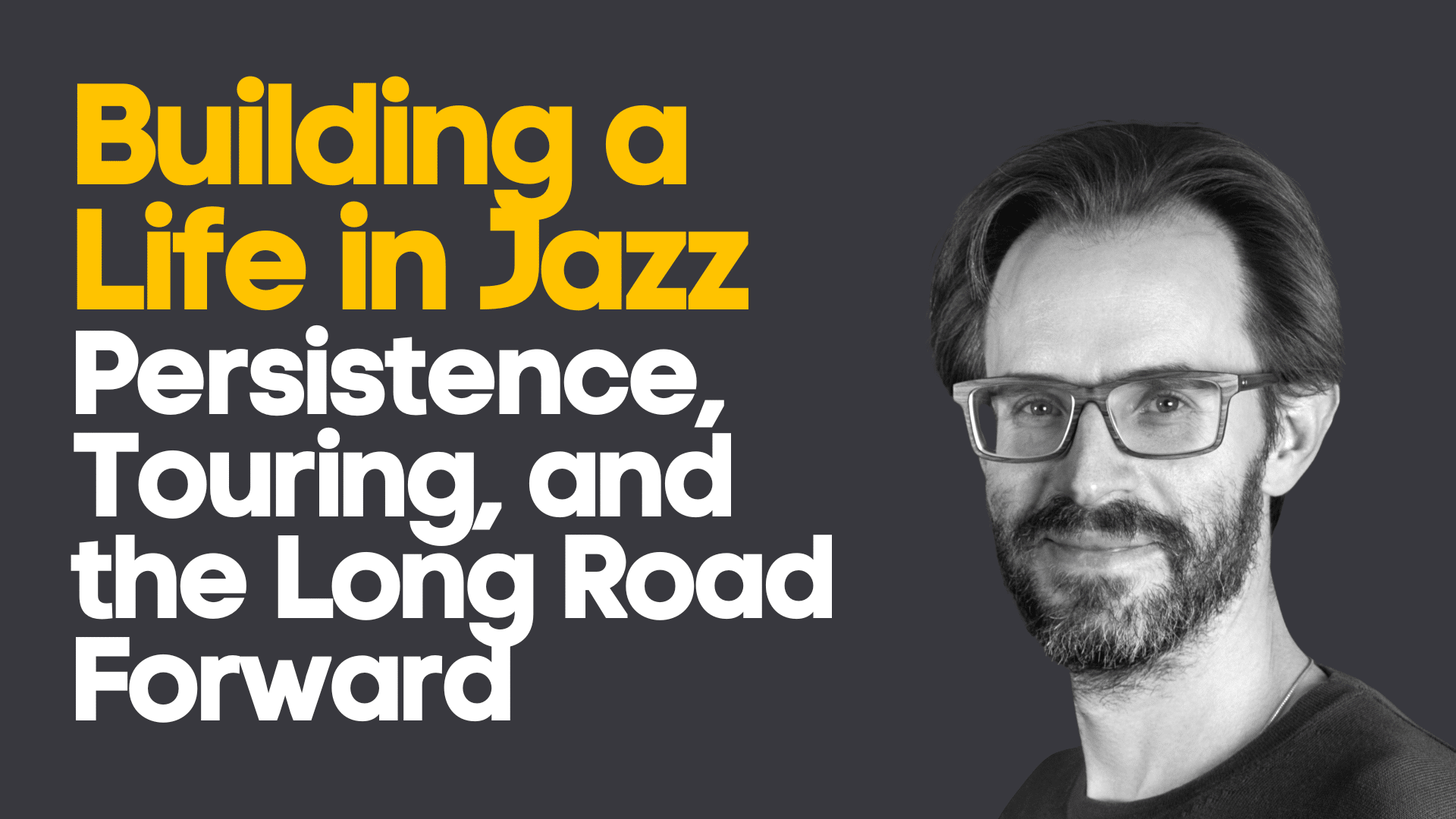
Over the course of two decades, the Austrian pianist, composer, and bandleader David Helbock, has carved out a distinctly international career—self-releasing albums as a teenager, touring the world through cultural exchange programmes, and ultimately finding a long-term home with ACT Music. Along the way, he has played thousands of concerts across continents while maintaining an unusually hands-on approach to every aspect of his work, from booking and travel logistics to video production and promotion.
In this conversation, he reflects candidly on the realities behind that journey: the persistence required to send thousands of unanswered emails, the balance between self-booking and agency support, and the practical lessons learned from touring, contracts, and sustaining ensembles over time.
He also speaks about community, patience, and the quiet belief that music—and even the smallest gesture of communication—can carry lasting positive energy. What emerges is less a story of sudden success than one of steady, determined movement shaped by resilience, curiosity, and an enduring love for the music itself.
I’ve interspersed the interview with some of his videos, to give you an idea of the music he is making, and booking!
You’ve built an international career as a bandleader, composer, and touring artist. Looking back, what were the key moments that helped you move from local projects to international touring and bookings?
I started very, very early doing my own musical projects as a leader and then also trying to get gigs with it.
I actually made my first “album” when I was 15. Back then I did everything myself – no label – I remember burning every CD one after the other (it took ages) until I had around 200 pieces to give/sell to my friends and relatives. Then later when I was around 19 I published my first “official” album – a solo piano record. For that I asked around really a lot and was trying to find a label – in the end it was published by a small, classical company in Vienna, called “Gramola”.
I learned a lot during that process, and already talked with many companies (including ACT), with whom I would then start to work with many years later.
Then in 2006 (when I was 22) we were able to release an album with our trio back then (HDV Trio) on the German label “Doublemoon Records” in cooperation with the German jazz magazine “Jazzthing”. That helped me to get more gigs outside of Austria, mainly Germany.
During that time we also got into a funding program of the Austrian government (called New Austrian Sound of Music) – in this program the Austrian embassies all over the world helped with contacts (and sometimes also travel costs), so I could already tour the world (also, for us, in exotic places, from Kazakhstan to Mexico, from Indonesia to Kenya and much more)
Later in 2010 I found a new home at the Berlin label “Traumton” (where I released five albums) and that helped a lot for bookings, especially in Germany.
In 2016 I played a concert with my trio at the big Jarasum Festival in Korea (also with the help of the Austrian embassy) and there I was lucky, that Siggi Loch (founder of ACT Music) heard us live. During that time I had already been in contact with Siggi for many years but that live gig made the difference and since 2016 I have already released seven albums on ACT.
I still kept going to book my own gigs, but the name ACT and of course their great press work helped a lot to establish the German speaking countries even more, but also to get more and more international gigs.
In the early stages of your career, how did you approach booking gigs yourself, and what helped you get those first tours or festival slots?
For me it was really step by step. I built up my email list of promoters more and more, starting out with maybe 50 clubs adding more and more over the years – and now I have a list of more than 5000 contacts. To be honest it was very frustrating in the beginning, not getting any answers at all. I really don’t like to brag and talk about my music – so calling via phone was always very difficult for me. So I focused mainly on e-mails. But there I was very persistent and did not really take “no” as an answer.
As already written, the Austrian Embassy program helped. I was able to get gigs all over the world with that and till to this day I have all those festival contacts and now some international tours are still possible without the embassies involved.
Later then I also tried different booking agencies – some with more success some with no success. But I always kept booking for myself and usually was faster and more successful when I did it myself. Some booking agencies helped especially in countries where it’s difficult, if you write an email in English – for example I really felt a difference and started to play in Italy or Spain more and more when I got help from an agency there.
For emerging musicians today, what are the first practical steps for moving from local shows to touring abroad? Any mistakes you made early on when reaching out to venues, promoters, or festivals?
It´s very, very frustrating when you start out. I would say in the beginning the % of getting feedback was around 1%. So I sent out 1000 mails and got around 10 answers, of which maybe 9 were declines. Now with my career going well and a lot of international press over the years and of course a much bigger e-mail list I would say it’s more like 2%. So sending out 3000 mails and getting maybe 50 answers, of which maybe 5 turn into real gigs.
But I also personalized and automatized my email list (I use the program MaxBulk) so it’s less and less work over the years. But still you have to take care of the email list, promoters at clubs change all the time, you have to be careful not to do too much “spam” but still send out infos regularly.
What helped me a lot are two things: One is almost a little spiritual. I strongly believe that I have to be in a good mood and have a positive energy when I send out e-mails. Not in a frustrated mode. I know that sounds pretty esoteric – but it helped me.
But the thing that helped me the most was changing sides a bit. I did the program at a jazz club (Spielboden in Dornbirn, western Austria) for around five years and I’m now doing the program of my own festival –www.jazzambach.at in Götzis (also western Austria).
So I’m on the other side and there I’m the one getting hundreds of emails. To see that and to see how much you get asked, helped me. It’s really nothing personal, if promoters don’t answer fast or don’t answer at all. Most of the time it’s just a lack of time.
But I experienced many funny situations like this. For example the promoter of a big German jazz festival was on my list for maybe 20 years. So I guess over the years he for sure got around 400 emails from me with so much different infos and music. He never replied once. I was trying to do spam checks and still I was sure that he received the emails. After around 20 years he wrote back once and offered me a gig with a concrete offer and a concrete date.
Sadly my musicians could not do the date and still to this day I have not played there :-). But for me the most “funny” thing was, when I told him that we are not available – he wrote: “no worries, we can try next year – but we are in contact anyway”. So he had the feeling that we were in contact anyway, because he got all my emails for more than 20 years. But still he did not reply once in 20 years. That was really funny and shows how the business works.
What’s your setup now in terms of booking, and how has that changed over time? At what point did you feel it was right to work with an agent or manager?
No phone (I hate that). Only emails. I organize it all in some excel sheets and personalize all the addresses. So it takes only one button to send a personalized email to all my addresses. Then the work is to find out who feels that it is spam, who might be interested, who should get another mail in a few weeks, which promoter changed, which club closed, etc.
And also adding new venues once in a while of course. I still check where all my colleagues play and then try to find out the right addresses.
I started working with an Austrian small agency (Eva Mikusch, Kunst+) about 15 years ago. But there we have the deal that I book myself and whenever she has something she adds to my calendar. Sometimes it was more, sometimes over the years it was less – but it was only always never more than 10% of my concerts, the rest I did myself. But it works well – we don’t have any exclusivity agreement or something like that – it’s just an add on.
I also tried other booking agencies but it did not work out so well. For one year I was with one of the biggest agencies in Europe – but during that year they only brought me 1 (!) concert. And I was sitting at home knowing that I could bring hundreds of concerts, if I would do it myself (but was not allowed to do so of course) – so I stopped that again.
Now I have different agencies in different countries (Scandinavia, Italy, France, Spain, Portugal, etc.) and once in a while they bring me 1-2 concerts. But still 90% of all the work I do myself. I’m just faster and can bring more with all my contacts. My premise is just to try to be nice to everybody and then you can find nice deals which are not really too exclusive and I’m just happy if I get a few gigs from agencies here and there but still can book myself without any “exclusivity” problems.
What qualities matter most in representation, and how important is personal chemistry?
You have to be nice. You have to be fast. Nobody wants to wait for an answer for a week or so. I always try to answer the same day. You have to build up a reputation that you are reliable and that the promoters can count on your word. I have played more than 3000 concerts in the last 20 years all over the world. And I never canceled one.
Also I don’t do contracts most of the time. The promoters know that they can count on me. For me an email agreement is enough. I also don’t have the time to do contracts with everybody, because I play so many shows. Of course I do contracts if the promoter wants one – but to be honest – usually the gigs where the promoter wants a long contract – those are the ones that cause problems afterwards 🙂
I know many promoters that invite “their friends” most of the time. I know that’s human of course. But that was never my cup of tea. I like to be professional, on time, fast with answers, correct with invoices etc, but I don’t want to start drinking beers with all the promoters after a concert. I know I lost some gigs because of that, but that’s my (sometimes more introverted) personality.
Do you think artists should actively seek representation, or wait until the industry comes to them?
Nobody will come to you. Maybe 1 musician out of 1000 is that good and that much of a genius that she or he can just play and wait and the industry will recognize anyway. But most of us are not. I think you have to get active as early as possible. And you have to take care of all different aspects of the business as well. I’m doing my own videos, I’m doing my own socials, my travel booking, contacting press, promoters, agencies, labels – the whole package from the beginning.
What advice would you give musicians trying to break into countries where they don’t yet have a network?
I like to help other musicians that I like and I’m also happy to share ideas. I don’t share my whole email list of course (that was just too many years of work), but I’m happy to exchange a few contacts here and there. So I would give the advice to be on the scene and be in contact with your colleagues. And when you see that one of your colleagues managed to get some gigs in a foreign country, reach out to them and exchange a few contacts. Like that I for example found my booker in Japan (where I’m now doing a solo piano tour again soon).
As already mentioned – the Austrian embassies helped me to get some contacts in countries far away. Some countries in Europe have that possibility, some don’t. It’s not easy. There are many jazz festivals (especially in poorer countries) who will only book you, if you have a sponsor (or an embassy) who pays for your flight. So trying to get funding (private or state money) is always important and part of the job. On the other hand, sometimes a gig at a festival in Asia or Africa is not always sustainable. It of course looks nice on your schedule, but sometimes nothing comes out of it and it could be just a one off gig, with no follow ups. But there is a chance that something develops and you can come back to that country.
As a bandleader, how much time goes into contracts, routing, and travel planning?
A lot. The bigger the band the more work. Doing that for a solo piano or a duo project is easy and sometimes around 20% of my work. But I had bigger bands where it got out of hand and was just too much, so I had to stop those projects to not run into a burnout.
For 2 years I have had a touring van myself. That is a luxury. It is pretty expensive, but for my mental health it’s great. I don’t have to think how we get from the train station to the venue and back, book all the train tickets and so on, but I can just get into the van with all the equipment and start driving, not thinking – which helps and opens up capacities for other things.
What have you learned about fees, contracts, and tour budgets that younger musicians should know early on?
As already written, I only do contracts with promoters who really want one. In my 3000 concert career as a leader I had it I think less than 5 times that a promoter did not pay and I had to hire a lawyer. And those were the ones where big, long contracts existed. One time I had a big, pretty known festival not paying and even a lawyer could not help – for my last idea to solve the problem, I wrote to the official sponsors of the festival and sure enough, one day later I had the money.
In terms of fees I of course started out very low and gradually increased the fees. I also feel a lot of responsibility for my musicians in my bands – so I just want to pay fair fees to them, even if I lose some money once in a while. But then a better paid gig shows up once in a while and there I take a little more then.
Usually (as I book most of it myself) I take 15% of the total fee as a booking fee (which is a common % also with agencies) – then we pay out all the travel costs and then we split it equally.
How important is online presence when it comes to booking gigs today?
I’m still not sure to be honest. I’m posting on Facebook and Instagram regularly and I also try to have a small budget to invest into social media promo once in a while. It helps a little bit. Especially with some concerts where there are not that many tickets sold already, you can push it a little bit, very locally in that specific town. Festivals are different, but in clubs you need to get an audience yourself because if you don’t manage that, you won’t be invited again.
I have some projects where my fellow musicians have much more followers on social platforms than myself (for example with French singer Camille Bertault or Austrian bassist Julia Hofer), but still I’m not sure how much that really helps.
Sometimes you get a few more people showing up at the concert – but the business of getting the concert (and being in contact with the promoter) is really a different thing than just having a lot of Instagram followers.
For sure there is a correlation, but many likes on socials do not always result 1:1 to streams, CD-sales or getting gigs. It’s easy to click on a “like” button but organizing a concert needs more dedication. Also for the audience, it’s easy to click on the “like” button, but that does not always mean that they are willing to also purchase an album or a concert ticket. Also I think the business around TV, radio, magazines, journalists is again something really different. I experienced cases where some musicians are really hyped by the jazz-community and press, but only have very little real following and album sales, and also the other way round of course – sometimes a lot of politics is involved too.
Do you feel pressure to create content, and how do you balance that with focusing on music?
Yes. I mean I really like to do videos. I started around 20 years ago – got some cheap cameras myself and used some old photo lenses of my grandfather with adapters on them and started to do my own videos from the start. I got into video cutting and I’m doing everything, also the audio recording myself. Now over the years we also did some video productions with professionals of course, but still over the years I now have around 10 cameras myself and the first demos of a new project I always do myself.
I realized how important that is many, many years ago, when we started out, with a funny story: I sent out some demos of my band “Random/Control” (only audio) and one promoter replied: “I like your band, very creative, but I can’t book you yet – you have to rehearse a little more, because the saxophones are not perfectly in tune” – then I knew we need a video. Because it was my trio and we only had one saxophone player, Andreas Broger, but he was playing two Saxophones at the same time, but that specific promoter did not realize that.
Nowadays I feel it gets less important, because during Covid many clubs invested in a lot of cameras to do streaming and they keep going and after a concert in those clubs you can get a pretty decent video. That’s cool, but of course now everybody has a great video, it’s nothing special anymore.
If you had to rebuild your career from zero today, what would you do in the first 12 months?
Promoters like fresh, young, new things. Most of them don’t want to book a band that plays together for many years, which is sad. They always want the new, hip thing – best if they can present the “premiere” of a project.
So I would find the best young, hip new players that nobody knows yet in the jazz scene. But I’m trying to do that anyway. That is how I found Julia Hofer, my new duo partner for example – she is actually coming more from the pop-world and I like that very much – it’s a different approach to music and rehearsing.
If you had to distill career-building into three core principles, what would they be?
Patience, Persistence, (don’t take “no” as an answer), but still try to be nice, professional and supportive all the time.
The jazz community is small and we are all in the same boat. Most promoters do their jobs with no (or very little) money – they try to make concerts happen just because they love the music. And I do the same. You don’t get into jazz to make money, you only get into this music, because you love it so much that you cope with all the hassle and business around it.
And to be honest, those are also the places you want to play anyway. Of course it’s nice to reach many people at a very big festival – but some of those venues are usually also more impersonal and colder – I also like to play in small clubs, where you know that the promoter gives all his love for the music to it and it’s never about money.
What helped me a lot is a positive energy mindset. I even got into buddhism this way and I’m chanting “Namu Myōhō Renge Kyō” regularly. Which translated means I believe in the “law of cause and effect”. I strongly believe that every note you play sends out some positive energy and lives on in the people who hear it. You can change the world that way in a very literal sense. Even more so, even if nobody hears it – the note and positive energy is still out there, I think.
But also every e-mail you write sends out energy. And that energy will come back somehow – maybe not always as you expect with a concrete answer or even a concrete booking, but it will come back sooner or later, just keep going.
Big thanks to David for sharing so openly and in so much detail! You can find him via his website and on socials.
www.davidhelbock.com/videos
www.davidhelbock.com
www.instagram.com/helbockdavid
www.facebook.com/davidhelbock
www.actmusic.com
GREAT STUFF !!!