

Buddy Rich remains one of the most formidable figures in the history of jazz drumming. Renowned for his astonishing speed and technical control, he was far more than a virtuoso technician. At his best, Rich combined power, precision, and swing in a way few drummers have ever matched – as the recordings in this article will show.
Behind the ferocious chops was a deeply musical player who understood how to drive a band, support soloists, and shape an entire performance from the drum stool.
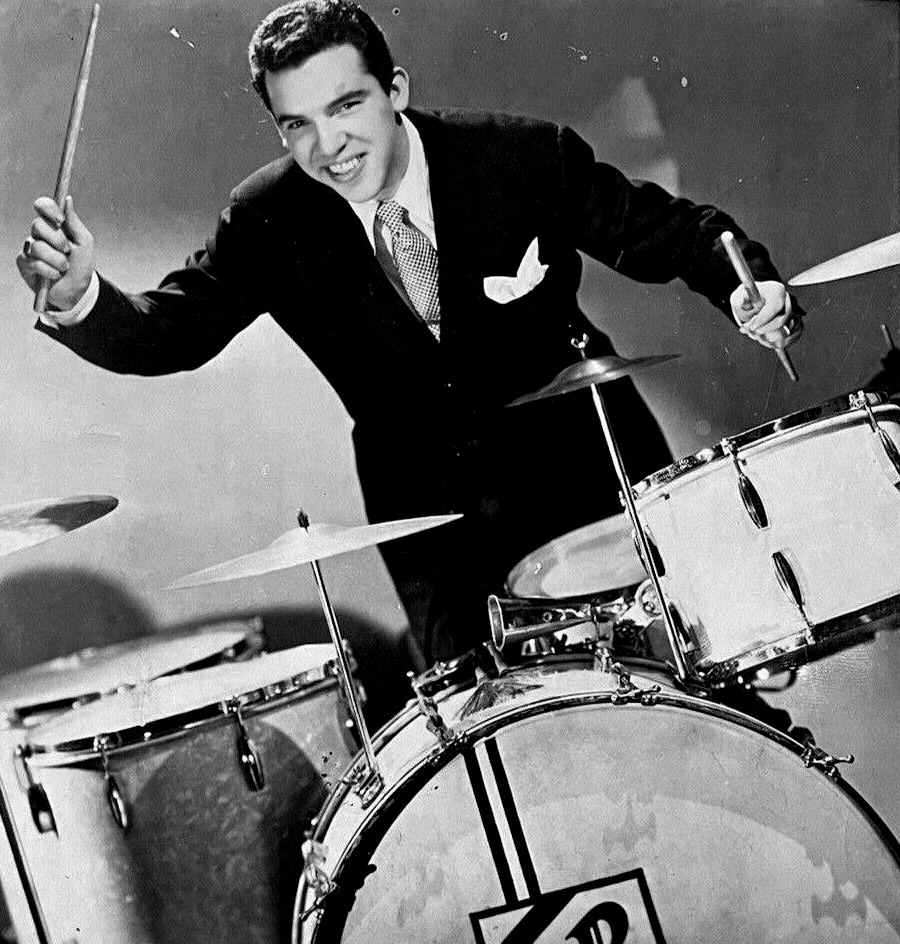
From vaudeville prodigy to big band leader, Rich’s career spanned more than five decades and left a lasting imprint on jazz, popular music, and modern drumming.
From Child Star to Jazz Professional
Buddy Rich was born on 30 September 1917 in Brooklyn, New York, into a family of vaudeville performers. By the age of two, he was already showing interest in rhythm, and before long he was appearing on stage as “Baby Traps the Drum Wonder”.
At just four years old, he was performing regularly in theatres across the United States.
Alongside drumming, Rich also sang and tap-danced, becoming one of the most successful child entertainers of his generation. His earnings were reportedly second only to Jackie Coogan, Hollywood’s first major child star.
As he grew older, Rich became increasingly drawn to jazz. He spent countless hours in clubs, absorbing the language of swing and developing the explosive style that would later define his career.
By his teens, he was leading bands of his own and establishing himself as a serious professional musician.
Big Bands, Bebop, and Early Fame
In the late 1930s and 1940s, Rich became a sought-after sideman, performing with many of the era’s leading orchestras.
He worked with:
- Artie Shaw
- Tommy Dorsey
- Harry James
These engagements placed him at the centre of the swing era and sharpened his skills as a big band drummer.
At the same time, Rich maintained close ties with the emerging bebop movement. He toured extensively with Norman Granz’s Jazz at the Philharmonic and recorded with Dizzy Gillespie and Charlie Parker — a rare crossover between big band virtuosity and modern jazz innovation.
Although he never embraced bebop stylistically, these experiences broadened his musical outlook and reinforced his reputation as a complete musician.
Buddy Rich: Temperament & Independence
Rich was famously strong-willed and often struggled with authority. His fiery temper and uncompromising standards became legendary among musicians – as documented on the incredible Buddy Rich bus tapes.
By the mid-1960s, he decided that working for others no longer suited him.
In 1966, he formed his own big band — a bold move at a time when most large ensembles were disappearing. Against expectations, the Buddy Rich Band became one of the most successful touring jazz orchestras of the era.
For audiences, seeing the band live was unforgettable: blistering tempos, immaculate ensemble playing, and Rich’s commanding presence behind the kit.
He would lead the group until his death in 1987.
Why Buddy Rich Still Matters
Technically, Rich set benchmarks that remain daunting even today. His single-stroke rolls, control at extreme tempos, and dynamic precision are still studied by drummers worldwide.
But his legacy goes deeper than speed.
Rich understood swing at a fundamental level. His time feel, phrasing, and interaction with soloists gave his playing musical purpose, preventing virtuosity from becoming empty display.
Equally important was his role as a bandleader. At a time when big bands were commercially unfashionable, Rich kept the tradition alive and introduced new generations to large-ensemble jazz.
The recordings below capture him at his best — in small groups, big bands, studios, and live settings.
The Best Buddy Rich Performances
Clap Hands, Here Comes Charlie (1959)
From Richcraft
This swinging standard opens with a characteristically confident drum introduction before launching into a driving ensemble performance.
Featuring Phil Woods, Benny Golson, Al Cohn, and Harry “Sweets” Edison, the session showcases Rich’s ability to propel an all-star lineup without overpowering it.
Limehouse Blues (1959)
From Rich Versus Roach
One of jazz’s most famous drum duels, this recording places Rich and Max Roach in separate stereo channels, allowing listeners to follow each drummer independently.
The result is both thrilling and instructive, revealing two contrasting approaches to rhythm at the highest level.
Caravan (1962)
From Blues Caravan
This sextet recording offers a modernised reading of the Ellington/Juan Tizol classic.
With Mike Manieri on vibes and Rolf Ericsson on trumpet, the arrangement highlights Rich’s versatility and musical sensitivity. His drumming here is colourful, dynamic, and never predictable.
Sister Sadie (1966)
From Swingin’ New Band
A powerful big band interpretation of Horace Silver’s composition, this track announces the arrival of Rich’s new orchestra in commanding fashion.
The rhythm section drives relentlessly, while Rich’s leadership keeps the ensemble tight and focused throughout.
My Man’s Gone Now (1966)
From Swingin’ New Band
This Gershwin ballad reveals a quieter side of Rich’s musicianship.
Using brushes and subtle dynamics, he provides sensitive accompaniment that supports the arrangement rather than dominating it — proof that restraint was part of his vocabulary.
Norwegian Wood (1967)
From Big Swing Face
An early example of Rich incorporating contemporary pop material into his repertoire, this live recording became a long-standing audience favourite.
Though Rich takes no extended solo, his authoritative timekeeping gives the performance its energy and momentum.
Straight, No Chaser (1971)
From A Different Drummer
Thelonious Monk’s composition receives a hard-driving big band treatment that few would have predicted.
Rich pushes the tempo aggressively, while Pat La Barbera and Jimmy Mosher deliver powerful solos. It is Monk, reimagined through sheer swing.
Milestones (1972)
From Very Alive at Ronnie Scott’s
Recorded live in London, this performance adapts Miles Davis’s modal classic for big band.
The arrangement retains the tune’s openness while adding orchestral weight. Rich’s drumming balances intensity with structural clarity.
Bein’ Green (1972)
From Stick It!
Here, Rich surprises listeners by stepping forward as a vocalist.
Best known as Kermit the Frog’s signature song, “Bein’ Green” is delivered with warmth and sincerity. His understated singing reveals a side of Rich rarely heard.
Nutville (1974)
From The Roar of ’74
Another Horace Silver composition transformed by Rich’s band, “Nutville” features additional percussion from Sam Woodyard and Jimmy Maulen.
The layered rhythms and crisp ensemble work highlight Rich’s ability to integrate multiple textures without sacrificing clarity.
Birdland (1978)
From Class of ’78
Joe Zawinul’s Weather Report classic becomes a big band showpiece in Rich’s hands.
Introduced into his repertoire within a year of its original release, “Birdland” reflects Rich’s awareness of contemporary jazz trends and his willingness to adapt.
Buddy Rich’s Enduring Legacy
It is difficult to overstate Buddy Rich’s influence on modern drumming. From jazz to rock and pop, generations of musicians have drawn inspiration from his technique, discipline, and intensity.
Drummers such as John Bonham, Phil Collins, and Roger Taylor have all acknowledged his impact. Even players outside jazz continue to study his recordings for insight into timing, control, and endurance.
Yet Rich’s greatest achievement may be that he kept swing music alive in changing times. Through relentless touring and uncompromising standards, he preserved the big band tradition for new audiences.
More than three decades after his death, his recordings still feel urgent and alive — reminders of what happens when technical mastery meets absolute commitment to the music.