When Elvin Jones began to establish himself on the New York scene in the 1950s, the reaction from other musicians was not universally positive. His playing didn’t behave in the expected way. Time didn’t sit neatly; it shifted, stretched, and layered.
Instead of reinforcing a steady pulse, his drumming seemed to move in several directions at once. For players used to a more clearly defined rhythmic framework, it could feel disorienting.
Looking back, it’s easy to hear this as innovation. At the time, it sounded like disruption.This article takes a closer look at what Jones was actually doing differently, why it took time to be understood, and how that approach became central to modern jazz drumming.
Alongside that, the interview below — filmed at The Village Vanguard with fellow-drummer Tony Moreno — offers Jones’s own perspective, from early criticism and financial struggle to his work with John Coltrane and the way he thought about rhythm from the inside.
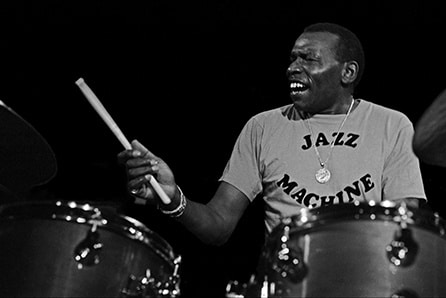
Jones himself was clear about how he was perceived. In his words, “Anytime a player plays against the norm, he’s considered one who rebels against the tradition.”
That sense of operating outside the accepted model wasn’t a pose or a deliberate attempt to provoke. It was simply the result of hearing rhythm differently.
At a time when the drummer’s role was still often understood in relatively fixed terms, Jones treated the instrument as something more fluid. The different parts of the kit weren’t confined to a single function. The hi-hat didn’t just mark time, the bass drum didn’t simply punctuate, and the ride cymbal didn’t exist as a stable reference point.
Instead, each element contributed to a broader rhythmic field, with multiple layers interacting continuously.
What later came to be described as polyrhythmic playing was, for Jones, a practical way of organising sound rather than a theoretical concept. As he explained it, the word “poly” simply meant many rhythms, coordinated together.
This approach didn’t replace timekeeping so much as expand it. The pulse remained present, but it was distributed across the instrument rather than stated in a single, consistent place. The effect is one of constant motion. Even at slower tempos, the music feels active and alive, with the rhythm section shaping the direction of the performance rather than just supporting it.
Elvin Meets Coltrane
The turning point came with John Coltrane.
Within that group, Jones’s playing no longer felt like an outlier. The music itself demanded a different kind of rhythmic flexibility, and his approach fitted naturally into that environment. He described the relationship in simple terms: everything he had been working towards suddenly had a place. The interaction within the band didn’t rely on explanation.
It was immediate, intuitive, and, as he put it, almost telepathic. In that setting, his drumming wasn’t just compatible with the music; it was central to how the music functioned.
What’s striking, listening back now, is how quickly something once considered unusual became foundational. The language of modern jazz drumming absorbed Jones’s ideas to such an extent that it’s difficult to imagine the music without them. The sense of rolling, multi-directional time that defines so much post-1960s jazz can be traced directly to his work in that period.
In conversation, Jones was less interested in analysing his own innovation than in describing how he actually built a performance. When asked about composition and improvisation, he often returned to the relationship between rhythm and melody.
Using pieces like “Three Card Molly” as examples, he showed how a simple rhythmic phrase could be developed across the drum kit, each limb adding weight and variation while remaining connected to the original idea. The complexity emerges gradually, not as decoration, but as a natural extension of the material.
He also spoke about sound in a way that moved beyond technique. Different tones suggested different colours to him; cymbals spread outward like ripples in water, while the hi-hat functioned more like a pulse within the body.
These descriptions aren’t presented as metaphors so much as observations. They offer a glimpse into how he experienced the instrument from the inside, and why his playing carries such a distinct sense of movement and texture.
There is, running through all of this, a clear awareness of the conditions in which the music was made. Jones didn’t present his career as a steady progression toward recognition or financial security.
Early on, he described not having money, scraping together enough to buy his first drum kit with help from his family. Later, reflecting on the broader reality of a life in jazz, he put it more directly:
“We may never see the pot of gold… but what we’re doing has lasting value.”
It’s a line that avoids both complaint and sentimentality. It acknowledges the uncertainty while insisting on the importance of the work itself.
The interview below with fellow-drummer Tony Moreno, filmed at The Village Vanguard by producer Ed Gray, brings these ideas together in Jones’s own voice.
He moves between practical explanation and personal reflection, from stories about early struggles to demonstrations of how he constructs a rhythmic idea. Rather than offering a retrospective summary of his career, it shows a musician still engaged with the process of making sense of what he does.
For anyone trying to understand his impact, Jones offered a straightforward suggestion. Instead of analysing the theory, listen across time. Hear a drummer before him, then listen to his playing, then to what followed. The shift is immediate.
What once sounded disruptive becomes, with hindsight, the point at which the language changed.
Looking for more?
Check out our guide to some of the greatest Elvin Jones recordings.