

In this article we’ve put together some info on the different types of saxophone accessories available today, plus some recommendations of which brands are best.
From more obvious products you probably already own like slings and cases, to less common accessories like saxophone mutes and key leaves.
First, though, if you’re just getting started, here are 5 things which every beginner saxophonist should consider…

A friend of mine had this at music college and his sax survived a fall down a flight of stairs!!

Very practical, but (from painful personal experience) be careful not to knock it over!
Every saxophonist knows that choosing an instrument and then pairing it with an appropriate mouthpiece and reed combination can be a daunting task.
We’ve already published an article on that very topic, as well one about the setups used by famous jazz musicians.
But, in fact, there are plenty of other items on offer that can help to optimise your playing experience.
So here’s our look at 10 of the best saxophone accessories. Feel free to let us know your own tips in the comments section at the end.
Saxophone cases
Most saxophones will arrive with a case when you buy them.
But like the basic mouthpiece that arrives with a brand-new horn, the bulky oblong case that comes as standard with many saxophones is likely to be one of the first things you consider upgrading.
They don’t come cheap though, and it’s worth thinking about what your priorities are…
- Do you need something that will survive daily bashes and bangs?
- Are you looking for a light sax case that can easily be carried around on foot?
- Do you want something as compact as possible that you’re more likely to be able to take on a plane as hand luggage?
- Do you want a saxophone case with lots of pockets and storage space?
Saxophone case manufacturers BAM make some of the most popular cases on the market.
Their Cabine model is about as neat and compact as a hard saxophone case can be. It’s also very light, but this comes at the cost of space: the crook needs to be stored in the instrument’s bell, so there’s no extra space, and if you want to bring a saxophone stand, for example, you’ll need an extra bag.
The Hightech model offers much more space, especially the version with the extra front pocket, but is a little on the heavy side, while the Trekking model is lighter and cheaper, but its softer material may make it a little less indestructible.
UK manufacturer Hiscox makes famously sturdy cases, although they are quite heavy, and the single-shoulder strap may be less comfortable than the rucksack-style straps used by other brands.
Eastman, with their shaped fibreglass cases, are also well-respected, but there are lots of other brands out there and it’s worth doing your research and thinking about what criteria is important to you before making a decision.
| Image | Product | Features | Price |
|---|---|---|---|
|
| Check Price on Amazon | |
 |
| Check Price on Amazon |
Gig bags
Gig bags are saxophone cases made from softer material, making them easier and more comfortable to transport around to gigs, concerts and rehearsals.
As you’d expect, they are lighter and often cheaper than hard cases, but this is likely to come at the cost of protection for your horn.
While the inside of gig bags will typically contain protective padding to shield against minor knocks, a soft case will not fare as well against major incidents in comparison to solid carbon fibre models, especially when travelling with a saxophone.
Still, if you are confident in your ability to keep your saxophone out of harm’s way, it may be a trade-off worth making in order to be able to easily and comfortably carry your instrument around town with you.
British brand Tom & Will make affordable soft cases, while Gewa’s products are slightly more contoured. Fusion’s Premium series is a high end kind of hard-case/soft-case hybrid that is specifically designed for the commuting saxophonist.
| Image | Product | Features | Price |
|---|---|---|---|
 |
| Check Price on Amazon |
Mutes
Depending on your living situation and whether you have access to a dedicated playing space, practising the saxophone can sometimes be tricky.
It’s not naturally a quiet instrument, and your neighbours may not appreciate those long tones or overtone exercises.
Brass instruments can use affordable and simple practice mutes, which are placed in the bell and bring the volume right down, but things are a bit more complicated on this front when it comes to the woodwind family, of which the saxophone is a member.
Saxophone mutes are a relatively new offering on the accessory market.
Typically, they look a bit like a saxophone case. Almost the entire horn is enclosed within the mute, with only the mouthpiece protruding. There are holes for the player’s arms to go through, so that his or her fingers can reach the keys.
It certainly looks and feels quite strange, but this should bring the volume down significantly, to around the level of normal conversation.
There is also a headphone jack so that you can hear yourself more clearly.
The E-Sax Whisper Mute is perhaps the most acclaimed model around, while the Saxmute One is a cheaper option, albeit with a slightly smaller reduction in decibel levels.
You can read reviews on both of these, and more, here.
Slings
The sling or neck-strap that that holds the saxophone around your neck may seem insignificant, but it can make a noticeable difference to how comfortable your playing experience is and, as such, is an important saxophone accessory.
The simple, unpadded fabric and plastic sling that arrives in your saxophone case might suit you fine, but you may find that one with some padding feels a lot nicer: Rico make popular and affordable models along these lines.
Some slings look more stylish than others, and there are various aesthetically pleasing options available, like Dave Guardala’s striking leather strap.
Some saxophone players claim that a metal hook aids reverberation and tone quality in comparison to plastic ones, although it’s not clear whether this has been proven by anyone!
Those prone to neck or back pain may like to try a harness-style strap, which aims to distribute the instrument’s weight more evenly.
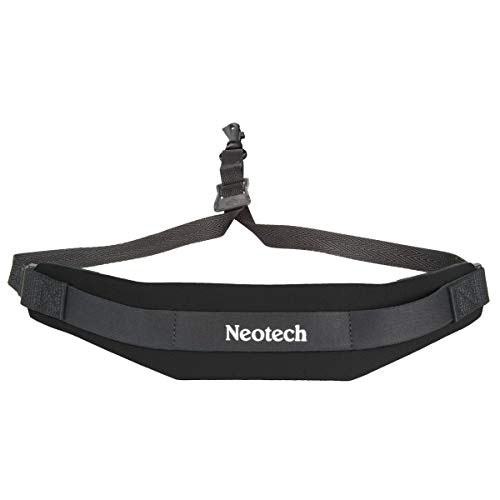
Vandoren do an ergonomically designed one with stabilising rods and a support belt, although there are simpler and cheaper versions available from BG and Neotech.
| Image | Product | Features | Price |
|---|---|---|---|
 |
| Check Price on Amazon | |
 |
| Check Price on Amazon | |
 |
| Check Price on Amazon |
Pull-throughs/swabs
These certainly aren’t the most exciting item on this list, but it’s really important to remove as much moisture from your saxophone as possible after each playing session, to keep the instrument healthy and your pads in good shape!
As such, it’s perhaps more of a necessity than a saxophone accessory!
In any case, it’s worth having a big pull-through cleaner for the main body of the instrument, as well as a smaller swab for your saxophone’s neck & mouthpiece.
Most comprise of a cloth with a long cord attached with a weight on the end: the weight is dropped through the saxophone and pulled out of the other end, bringing the cloth and any moisture out with it.
French company BG’s pull-throughs are recommended, although