

Jazz history tends to focus on albums that announce change clearly. Records that sit between eras or styles can be harder to place and easier to overlook. Yusef Lateef’s catalogue contains several such examples.
When the career of Yusef Lateef is discussed, attention usually centres on one part of his work: the early-1960s recordings that introduced non-Western instruments and modal ideas into jazz long before they were widely accepted. Albums like Eastern Sounds tend to define his reputation, framing him primarily as a spiritual or exploratory figure.
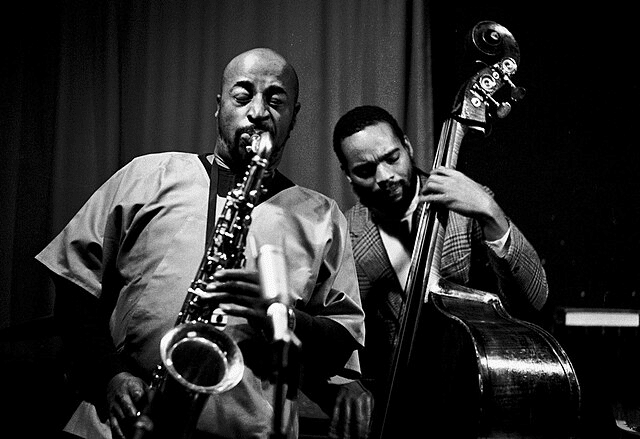
That focus leaves other parts of his catalogue largely unexplored — particularly his late-1960s recordings, which don’t fit neatly into the familiar narratives of spiritual jazz, hard bop, or fusion.
One of those records is Yusef Lateef’s Detroit (Latitude 42° 30′ Longitude 83°), recorded in February 1969 and released later that year on Atlantic Records.
A record tied to place, not scene
The album’s subtitle is literal. Latitude 42° 30′, Longitude 83° marks the location of Detroit, the city where Lateef grew up.
Rather than presenting Detroit as a jazz “scene” or tradition, the album treats the city as a collection of specific locations. The track titles read like a map: Bishop School, Livingston Playground, Eastern Market, Belle Isle, Russell and Elliot, Woodward Avenue.
These are everyday places — schools, streets, public spaces. There’s no explanation or symbolism attached to them. The implication is simple: these places mattered to him.
In that sense, Detroit isn’t a documentary or a retrospective. It’s closer to a set of recollections organised through sound.
1969 and the wider jazz context
The timing of the album matters.
By 1969, jazz was in the middle of a major shift. Electric instruments were no longer controversial. Groove-based structures were increasingly common. Free jazz had disrupted traditional forms, while soul jazz and funk were pulling jazz closer to popular Black music of the time.
Lateef’s response was not extreme in any direction. Detroit doesn’t pursue free improvisation, nor does it chase the emerging fusion sound associated with Miles Davis’ work from the same period. Instead, it settles into a controlled, groove-based approach that resists easy classification.
That ambiguity is part of why the album has often been described as misunderstood.
The ensemble and production
This is not a small-group jazz record.
Lateef assembled a large, studio-oriented ensemble that included Bernard Purdie on drums, Chuck Rainey on electric bass, Eric Gale on guitar, Hugh Lawson on piano, Cecil McBee on bass, Ray Barretto and Norman Pride on congas, and a trumpet section featuring Thad Jones, Jimmy Owens, Snooky Young and Danny Moore. Several tracks also include a string section.
The presence of both acoustic and electric bass, layered percussion, and strings places the album firmly in the late-1960s Atlantic sound world. Producer Joel Dorn keeps the balance tight, avoiding both clutter and sparsity.
This is a group built for texture and control rather than extended soloing.
Lateef’s role within the music
Lateef appears on alto saxophone, tenor saxophone, flute, oboe and voice, but rarely positions himself as the dominant presence.
His lines tend to function as part of the overall structure rather than as focal points. Solos are concise. Nothing feels designed to impress. In that sense, Detroit feels more like a composer’s record than a soloist’s record.
The emphasis is on pacing, arrangement and feel.
Groove without excess
Much of the album is built on steady, grounded grooves, but they are used with restraint.
Tracks like Eastern Market and Belle Isle move forward without urgency. The rhythm sections lock in, but they don’t escalate. There are no dramatic builds or climactic solo sections.
Electric bass and percussion are present throughout, but they don’t push the album into fusion. The grooves sit where they sit.
This measured approach sets the album apart from many contemporaneous records, particularly those leaning toward density or confrontation.
Why the album sits outside the canon
One reason Detroit has remained outside the core jazz canon is that it doesn’t confirm expectations.
Listeners coming from Lateef’s earlier spiritual work may find it surprisingly grounded. Those expecting Detroit hard bop may find it too studio-based. Listeners looking for late-1960s experimentation may find it too controlled.
It sits between categories, and that has made it harder to place historically.
Rediscovery and reissue
For many years, Detroit was difficult to find on vinyl. In 2023, the album was reissued in the UK for Record Store Day as a limited pressing curated by Gilles Peterson and remastered from the original tapes by Bernie Grundman.
The reissue prompted renewed attention and made it easier to hear the album on its own terms, removed from the expectations attached to Lateef’s better-known work.