
Review by: Tim Larsen
Resonance Records
Rahsaan Roland Kirk – tenor sax, manzello, stritch, flute, whistle, vocalizations; Horace Parlan – piano; Melvin Rhyne – piano; Jane Getz – piano; Henry Grimes – bass; Sonny Brown – drums
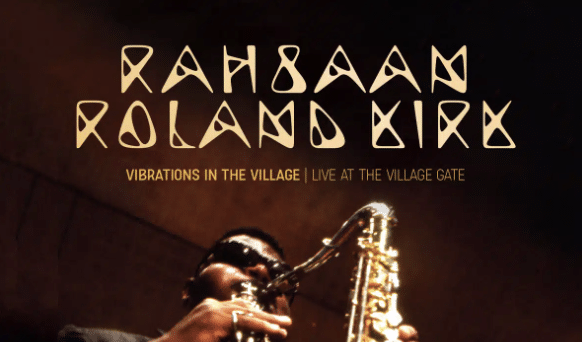
Some Rahsaan Roland Kirk recordings begin in the middle of the action, and Vibrations in the Village does just that, throwing you into the band’s relentless energy. This newly uncovered Village Gate set — pulled from long-forgotten tapes from an unfinished documentary — captures one of jazz’s most innovative multi-instrumentalists at a pivotal moment—1963, before he’d add ‘Rahsaan’ to his name.
The band shifts pianists throughout the night — Horace Parlan, Melvin Rhyne, and Jane Getz — with Henry Grimes on bass and Sonny Brown on drums keeping everything grounded. When Kirk steps in, the music opens up. He moves between tenor, stritch, and manzello, sometimes layering them so a single line multiplies into harmonies that weave around one another. At moments a flute slips in, or a whistle, and it becomes a chorus of voices, turning one player into a full sax section and filling the room with a sound that feels impossibly big.
Horace Parlan pushes right through the distant piano mic with lines that stay crisp and purposeful. On “Jump Up and Down Fast,” his solo clears a path in the middle of the tune, giving Kirk room to dart on manzello and stack horns into a tidal wave of sound.
On Mingus’s “Ecclusiastics,” Parlan leans into the tune’s gospel warmth, giving Kirk a steady, glowing backdrop. Kirk answers with his big, bluesy sound on tenor and a mix of shouted “yeahs,” half-sung lines, and quick jabs at then-Governor Wallace of Alabama. Kirk never shied from addressing the moment—civil rights, politics, whatever was happening—right from the bandstand. Then the sound widens—one horn becomes two, then three—the horns multiply, weaving a tight, shifting harmony over Parlan’s chords. Parlan’s solo slips in clean and swinging, with Kirk humming along behind him before returning on tenor and briefly opening the horn stack again. It’s loose, funny, and alive, and Parlan keeps the whole thing grounded.
Kirk was one of the greatest flute players jazz ever had. He loved taking well-known tunes and bending them into his own shape. On “Laura,” the melody starts clean and lovely, then he twists a note, leans on a little overblow, and suddenly it’s a Kirk piece. He gives Melvin Rhyne space to stretch out, and when Kirk returns, the flute carries a slight vibrato and an edge he could summon at will.
“Kirk’s Delight” kicks in with tenor lines that snap and bite, Parlan’s chords answering every phrase as Kirk shifts from low simmer to full-throttle. Horns layer and drop away; his tone is crystal clear, in your face. On “Oboe Blues,” he slows into a slinky groove, and the stritch — his straight alto sax — sounds almost like an oboe, exotic and a little Middle Eastern, floating over Parlan’s piano and the bass’s warm foundation. Then multiple horns swell together, a choir erupting from one man, leaving no doubt who’s in charge.
The finale, “Three for the Festival,” is pure joy: Jane Getz races through nimble, darting lines on piano as Kirk sings through the flute, overblows, and even weaves in what sounds like nose flute. It’s wild but focused, the two of them trading energy and ideas all the way out.
Vibrations in the Village captures Kirk at his most fearless, funny, and full of ideas, and Resonance Records has brought it back for the world to hear. They are also releasing another Kirk gem, the 1967 date Seek and Listen: Live at the Penthouse.