

Paul Desmond never tried to overpower a band. Where many alto saxophonists chased volume and fire, Desmond built his reputation on understatement — a dry, floating tone, elegant phrasing, and an almost conversational approach to improvisation.
Best known as the voice of the Dave Brubeck Quartet and the composer of “Take Five”, he became one of the most recognisable stylists in modern jazz without ever sounding forceful.
This guide explores ten Paul Desmond songs that capture his unique musical personality, from early college concerts to his refined late recordings.
Paul Desmond 101
Born Paul Emil Breitenfeld on 25 November 1924, Desmond began on clarinet at the age of twelve before switching to alto saxophone after high school.
He studied English at San Francisco State College and developed a lifelong love of literature, humour, and wordplay — traits that later surfaced in both his music and interviews.
Influenced by players such as Lee Konitz and Lester Young, Desmond gravitated towards the emerging “cool jazz” aesthetic: light tone, relaxed swing, and melodic clarity.
By the late 1940s, he was already establishing himself as one of the most distinctive voices on the West Coast scene.
Desmond’s career became inseparable from pianist Dave Brubeck in the early 1950s. Their partnership was not always easy. The two were known to argue, and Brubeck maintained tight control over the group’s recordings and contracts.
Yet musically, they were perfectly matched.
Brubeck’s block chords and rhythmic experiments created space for Desmond’s lyrical improvisations.
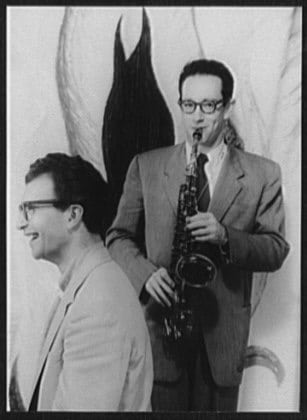
Together, they built one of jazz’s most commercially successful and artistically consistent quartets – as you’ll here in several of these iconic Dave Brubeck performances we’ve selected.
Paul Desmond Songs
1. The Way You Look Tonight
Jazz at Oberlin (1953)
Recorded live at Oberlin College, this early performance captures the Brubeck Quartet’s youthful energy.
Desmond’s tone is already fully formed — light, liquid, and remarkably controlled at speed. His solo flows effortlessly across the changes, revealing a mature stylist still in his twenties.
2. Balcony Rock
Jazz Goes to College (1954)
Built on an eight-bar blues framework, this relaxed performance highlights Desmond’s gift for slow-burning development.
Rather than piling on ideas, he shapes a single melodic thread and lets it unfold naturally.
It is a masterclass in patience.
3. Some Day My Prince Will Come
Dave Digs Disney (1957)
Brubeck’s Disney project might have seemed whimsical, but Desmond takes the material seriously.
His solo is built from small, carefully placed phrases that gradually accumulate into a coherent narrative.
The tune later became a major jazz standard, famously recorded by Miles Davis.
4. Take Five
No list of Paul Desmond songs is complete without “Take Five”.
Written in 5/4 time, it became the first jazz single to sell over a million copies.
Desmond once joked that it was meant to showcase drummer Joe Morello — not become a hit.
Its relaxed melody and hypnotic rhythm proved irresistible.
5. Late Lament
Desmond Blue (1962)
On this lush, string-backed album, Desmond steps away from Brubeck’s angularity.
“Late Lament” reveals his romantic side, with guitarist Jim Hall providing subtle counterpoint.
It remains one of his most emotionally direct recordings.
6. Two of a Mind
with Gerry Mulligan (1962)
Paired with baritone saxophonist Gerry Mulligan, Desmond explores a rare chordless format.
Without piano or guitar, the two horns weave around each other freely.
The result is light, witty, and remarkably balanced.
7. Take Ten
Take Ten (1963)
A companion piece to “Take Five”, this composition also uses 5/4 time.
While less famous, it shows Desmond refining his rhythmic ideas in a more intimate setting with Jim Hall.
The familiarity is intentional — and effective.
8. Any Other Time
Glad to Be Unhappy (1965)
This understated original appears on an album devoted largely to standards.
Here, Desmond sounds almost austere: no excess, no ornamentation, just pure melodic logic.
It is one of his most disciplined performances.
9. Blues for Fun
Easy Living (1966)
Recorded near the end of his partnership with Jim Hall, this track lives up to its title.
Desmond sounds relaxed, playful, and liberated from formal restraint.
It is an ideal entry point into their duo chemistry.
10. Warm Valley
Pure Desmond (1975)
Recorded late in his career, this Ellington standard finds Desmond working with Ed Bickert, Ron Carter, and Connie Kay.
Although his health was declining, his control and clarity remain intact.
The tone is lean, focused, and quietly authoritative.
A lifelong heavy smoker and drinker, Desmond was diagnosed with lung cancer in the mid-1970s.
He continued recording and performing when possible, but his health deteriorated rapidly.
He died on 30 May 1977, aged just 52.
Paul Desmond’s Legacy
Paul Desmond was never a virtuoso in the conventional sense. He did not chase speed, volume, or technical display. Instead, he built a career around tone, balance, humour, precision, and emotional restraint.
His influence can be heard in players from Lee Konitz to Anthony Braxton, and in generations of alto saxophonists who learned that understatement could be just as powerful as intensity.
More than anything, Desmond showed that jazz improvisation could be intimate, elegant, and quietly persuasive.
In a music often driven by competition, he chose conversation. And that choice remains his most enduring contribution.