
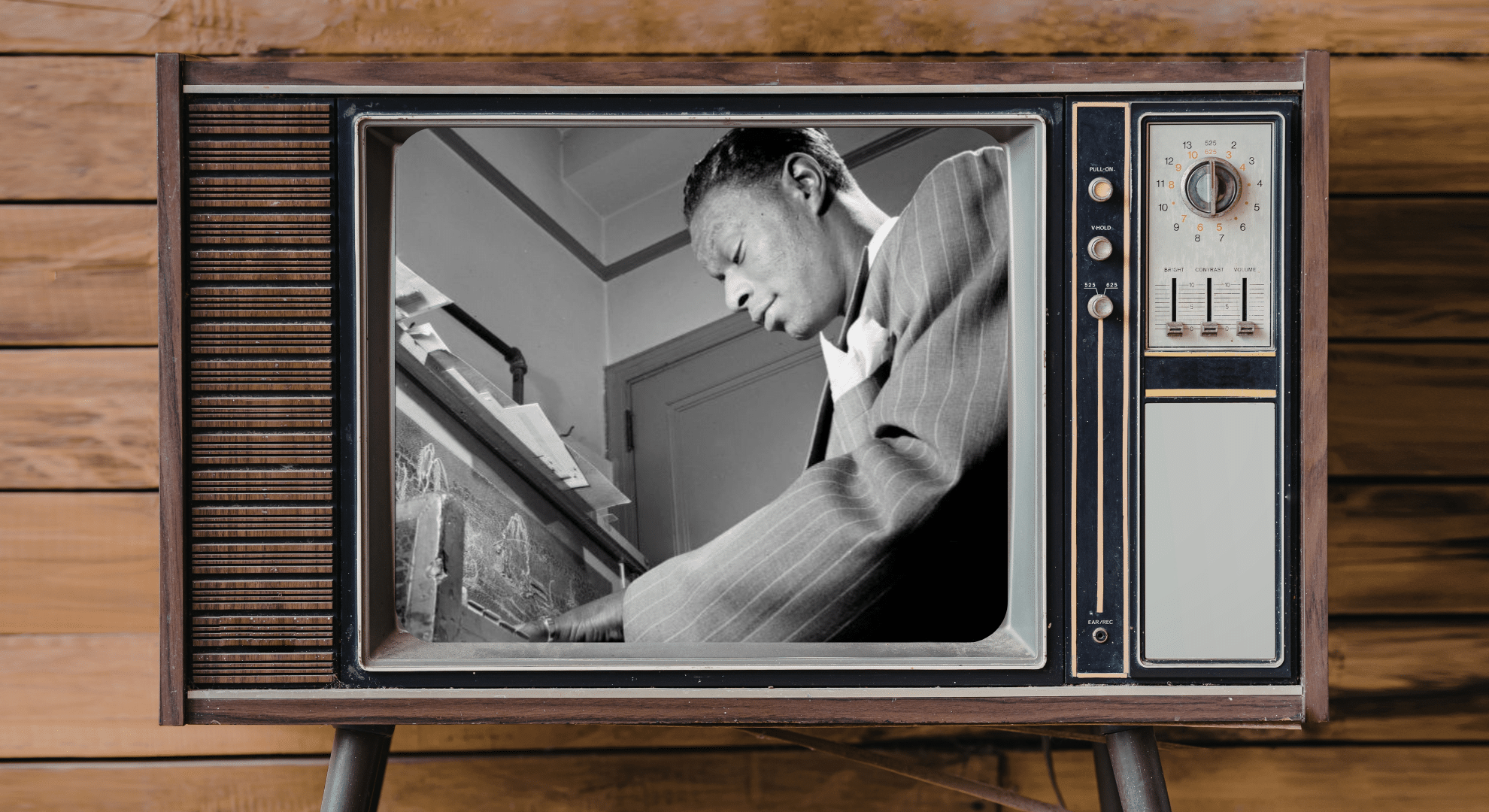
Some jazz clips feel alive the moment you press play. Others feel… slightly removed. Not worse — just different.
This short colour film of Nat King Cole performing “Nature Boy” falls into that second category. At first glance, it looks like a standard filmed performance: Cole at the piano, an orchestral arrangement behind him, everything neatly framed for the camera.
But this isn’t a concert, and it isn’t a scene from a film. It comes from something called a Snader Telescription.
What Are Snader Telescriptions?
In the early 1950s, television was still finding its footing. There weren’t enough programmes to fill entire broadcast schedules, and stations needed short, flexible content they could drop in between shows.
Enter Snader Telescriptions.
Produced between 1950 and 1952, these were short filmed performances — usually around three minutes long — featuring popular musicians of the time. They were designed to be distributed to television stations as ready-made content.
In many ways, they function like an early version of the music video. Artists would perform one of their well-known songs in a controlled studio environment, often miming to a pre-recorded track. The setup was simple, the lighting was direct, and the focus was on presenting the artist clearly to the viewer.
Nat King Cole at a Turning Point
By the time this clip was filmed, Nat King Cole had already made a significant transition in his career. He began as a jazz pianist, leading the Nat King Cole Trio — a small, highly influential group known for its tight interplay and stripped-down sound.
But by the late 1940s, Cole’s success as a vocalist had transformed his public image.
“Nature Boy,” first recorded in 1948, became one of his defining songs. With its unusual melody and orchestral arrangement, it marked a move toward a broader, more commercial sound that would bring him international recognition.
This performance reflects that shift.
The strings, the pacing, the visual presentation — everything is designed to highlight the voice rather than the piano.
A Different Kind of Presence
What stands out in this clip is not spontaneity, but control. Unlike a live performance, there is no risk here. The tempo is fixed, the arrangement is set, and the camera frames every movement carefully.
Cole’s delivery is calm, measured and precise. He plays the role expected of him: the composed, elegant performer, fully at ease in front of the camera. And yet, something still comes through.
Even within this structured setting, his phrasing retains a sense of individuality. The way he shapes the melody, the slight variations in timing, the relaxed approach to the line — these are the elements that connect back to his jazz roots.
From Bandstand to Screen
Clips like this capture an important moment in the history of jazz.
During the 1920s and 30s, jazz was primarily experienced live — in clubs, ballrooms and theatres. By the 1940s, recordings had already changed how audiences engaged with the music.
Now, with early television and filmed performances, another shift was taking place. Music was becoming something you could watch. But in the process, something else changed as well.
The interactive, unpredictable nature of live jazz — the back-and-forth between musicians — was often replaced by a more controlled, presentational style.
That doesn’t make these performances less valuable. It just means they show a different side of the music.
Why This Clip Still Matters
It would be easy to dismiss a clip like this as staged or overly polished. But that would miss the point. What makes it interesting is precisely that sense of control.
It shows how artists like Nat King Cole were being positioned for a new kind of audience — one that encountered music not in a crowded room, but through a screen.
And it shows how jazz musicians adapted. Even within a fixed format, Cole’s musical personality remains clear. The phrasing, the tone, the sense of space — all the elements that defined his earlier work are still present, just framed differently.
If live recordings tell us how musicians sounded, and studio recordings show us how they refined their work, clips like this reveal something else.
They show how musicians were presented. How they were seen. And how the medium itself began to shape the message.
For Nat King Cole, “Nature Boy” became one of the songs that defined his career. This short film captures that moment — not in a club, not in a studio session, but in a carefully constructed visual format that was quietly pointing toward the future of music.
You can find out more about Snader Telescriptions here.