

We’ve already published a deep-dive into the story of the Mahavishnu Orchestra, but their early days and original line-up certainly deserves a spotlight… and the BBC television footage from 1972 below seemed like the perfect excuse!
By the early 1970s, jazz was already changing.
Electric instruments had begun to reshape the sound of the music, and artists like Miles Davis had opened the door to new forms that blended jazz with rock, funk and extended improvisation.
But when the Mahavishnu Orchestra emerged in 1971, it felt like something different again.
Led by guitarist John McLaughlin, the band brought together a level of intensity, precision and compositional ambition that pushed fusion into new territory.
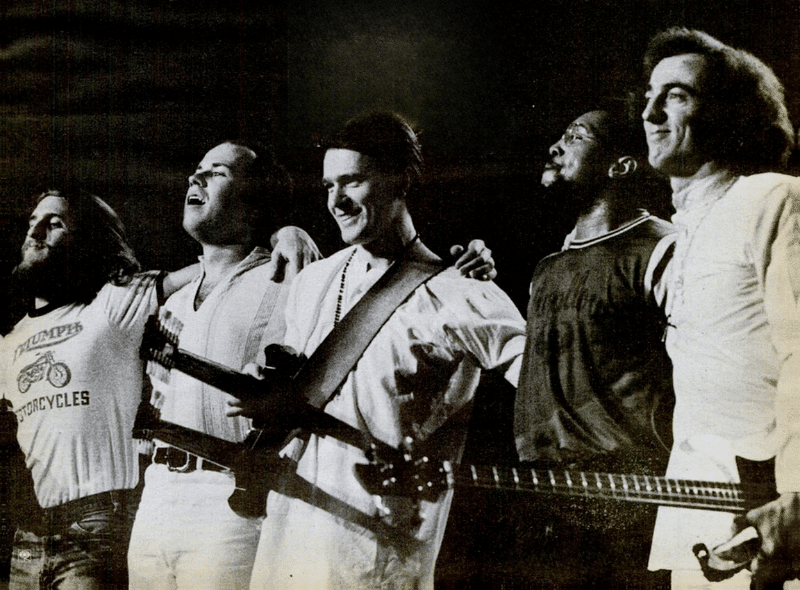
The footage embedded below, filmed by the BBC in 1972, offers a clear glimpse of that early lineup in action.
A Lineup Built for Speed and Precision
This original Mahavishnu Orchestra featured:
- John McLaughlin – guitar
- Jan Hammer – keyboards
- Jerry Goodman – violin
- Rick Laird – bass
- Billy Cobham – drums
Each musician had a distinct background, but the group’s identity came from how tightly those voices were combined.
Unlike many jazz groups of the time, this wasn’t a band built around extended solos over a steady groove. Instead, much of the music was based on intricate written passages, often played in unison at high speed, with sudden changes in rhythm and dynamics.
That demanded an unusual level of discipline.
It also created a sound that, for many listeners at the time, felt almost overwhelming.
A Different Kind of Fusion
By 1972, “jazz fusion” could mean several things.
Some artists were moving toward looser, groove-based music, focusing on atmosphere and texture. Others leaned more heavily into rock rhythms and amplification.
Mahavishnu Orchestra took a different path, combining fast tempos, complex time signatures and tightly structured compositions with a level of energy more commonly associated with rock.
The result was something that didn’t sit comfortably in either category. It was too complex to be rock, but too aggressive and amplified to resemble earlier forms of jazz.
That tension became part of the band’s identity.
The Live Sound
Studio recordings such as The Inner Mounting Flame (1971) and Birds of Fire (1973) introduced the group’s approach, but live performances revealed just how demanding the music really was.
The BBC footage shows a band operating at full intensity.
What stands out is not just the speed, but the coordination. Lines are executed with precision, transitions happen quickly, and the rhythm section maintains a constant sense of forward motion even as the structure shifts.
At the same time, the music never feels static.
There is a sense of risk in the performance — the possibility that things could come apart — which adds to the overall impact.
A Short-Lived Mahavishnu Orchestra Lineup
Despite its influence, the original Mahavishnu Orchestra existed for only a brief period.
Internal tensions within the group led to its breakup in 1973, just as it was reaching a wider audience. A later version of the band, with a different lineup, would move in a more orchestral and composition-focused direction.
For some listeners, that later phase represents a natural development of McLaughlin’s ideas.
For others, the early lineup captured something unique — a balance of intensity, discipline and spontaneity that was difficult to sustain.
Why This Period Still Matters
More than fifty years later, the early Mahavishnu Orchestra recordings remain central to discussions of jazz fusion.
They influenced later fusion groups, progressive rock musicians and technically focused jazz players. But beyond influence, there is something else that continues to resonate.
The music still feels challenging.
Even now, it can sound dense, fast-moving and demanding in a way that rewards repeated listening. That sense of difficulty — of music pushing against its own limits — is part of what defined the band.
A Moment Captured on Film
High-quality footage of the Mahavishnu Orchestra from this period is relatively limited.
Television recordings like this BBC session provide a rare opportunity to see how the group functioned in real time — not just as a set of recordings, but as a working band navigating complex material on stage.
For listeners familiar with the albums, it adds an extra layer of context.
For others, it serves as a direct introduction to a group that helped reshape the direction of jazz in the early 1970s.
The question that still comes up today…
So, we’ll leave you with the obvious question: was this the definitive Mahavishnu Orchestra — or simply the most intense version of it?
Let us know your thoughts in the comments section below.