

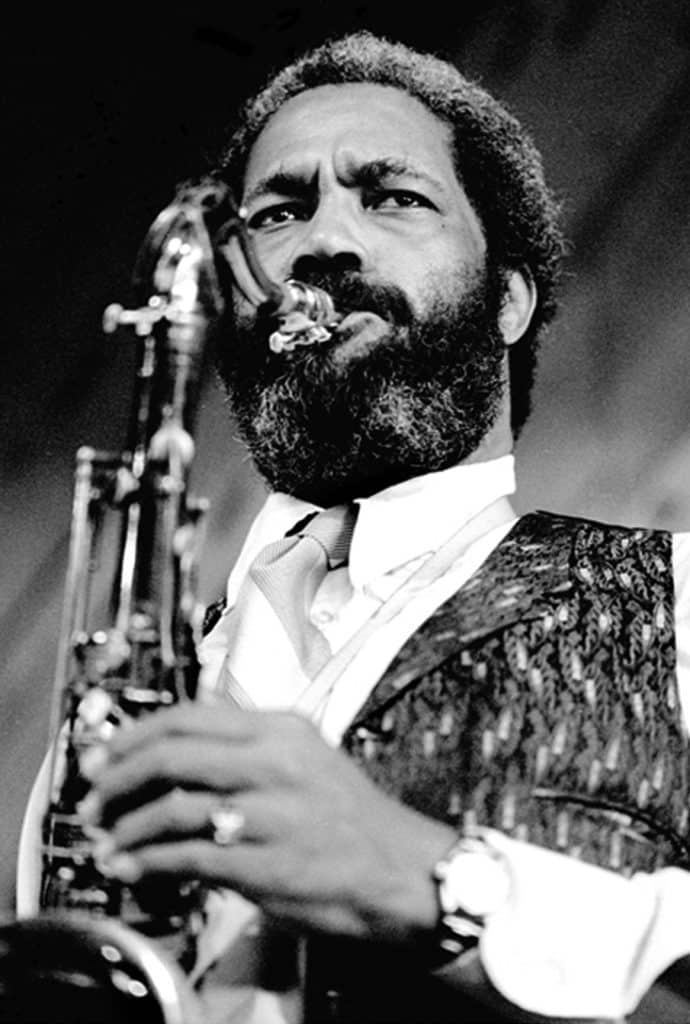
Clifford Jordan’s tenor does not rely on flash.
The tone is firm but never rigid, weighty without becoming dense. When he leans into a phrase, the sound widens rather than sharpens. Over decades of recording, that balance—force contained within clarity—remains his defining trait.
Listening across Clifford Jordan albums reveals a musician who trusted form. Even when the harmonic language broadened in the 1970s, even when spiritual jazz currents entered the picture, the core remained steady. The music unfolds in long arcs. Nothing feels hurried. Nothing feels accidental.
From Chicago Hard Bop to Independent Authority
Born in Chicago in 1931, Jordan emerged from a scene shaped by blues phrasing and disciplined ensemble playing. Early professional work alongside Max Roach and others sharpened his rhythmic endurance and structural command. The Chicago environment favored directness over abstraction, and that grounding would remain audible throughout his career.
Unlike some contemporaries who pivoted sharply into avant-garde territory during the 1960s, Jordan evolved gradually. His sound absorbed modal openness and freer rhythmic elasticity without abandoning the blues-centered architecture that defined his earliest work. The result is a discography that feels continuous rather than segmented.
Hard Bop Foundation: Cliff Craft (1958)
Released in 1958, Cliff Craft stands among the earliest essential Clifford Jordan albums. The session reflects hard bop’s muscular clarity—clear themes, forward momentum, and rhythm-section propulsion that never overwhelms the soloist.
Jordan’s improvisations develop patiently. Instead of relying on bursts of speed, he builds motifs across choruses, returning to small rhythmic cells and stretching them into longer statements. The tone carries a slight edge at higher intensity, yet articulation remains precise.
Even here, the seeds of later endurance are present: structure first, heat second.
Expanding Within the Form: Spellbound (1960)
By 1960, the harmonic field begins to widen.
Spellbound retains hard bop grounding while allowing phrasing to breathe more freely across bar lines. Jordan’s lines extend slightly beyond symmetrical patterns, hinting at the modal thinking that would become more pronounced in later recordings.
Among early Clifford Jordan albums, this session marks the first clear step toward broader compositional imagination. Yet nothing feels like departure. The blues thread remains woven through every chorus.
Collective Depth and Spiritual Reach: Glass Bead Games (1974)
Recorded in 1973 and issued in 1974, Glass Bead Games represents one of the most admired Clifford Jordan albums and a turning point in his catalogue. The ensemble—carefully assembled and deeply interactive—supports extended compositions that unfold gradually, almost ceremonially.
Themes are introduced with restraint. Rhythmic patterns interlock rather than dominate. Solos emerge organically from the group texture. The atmosphere leans toward spiritual jazz, yet the structural discipline never dissolves.
Jordan does not chase transcendence; he constructs it.
This recording expanded his audience and confirmed that his steady approach could adapt to the era’s broader aesthetic without losing identity.
Quartet Cohesion and Modern Swing: In the World (1972)
By the early 1970s, Jordan’s quartet language had achieved remarkable cohesion.
In the World emphasizes ensemble listening as much as individual statement. The rhythm section moves with flexible swing rather than rigid drive, allowing Jordan to stretch phrases with confidence.
The tone deepens here—less grain, more rounded authority. Improvisations travel in long arcs, guided by internal logic rather than momentary impulse. Across Clifford Jordan albums from this period, maturity becomes audible not as slowing down but as settling into full command.
Refinement Without Retrenchment: Repetition (1984)
The title suggests persistence, but the music reveals refinement.
Repetition revisits blues frameworks and modal structures without redundancy. Jordan pares ideas down, allowing silence to shape the contour of phrases. Notes land decisively, and the rhythm section responds with subtle dynamic shading.
Rather than expanding outward, this recording turns inward—tightening language without shrinking it.
Late-Career Authority: Down Through the Years (1992)
Recorded near the end of his life, Down Through the Years gathers earlier strengths into calm, deliberate form. The tempos are measured. The phrasing wastes nothing. Jordan’s tone retains its firmness, yet the emotional temperature feels steadier, less urgent.
Nothing in these performances sounds retrospective.
Instead, they feel assured.
The endurance suggested in the album’s title reflects the larger arc of Clifford Jordan albums themselves—a body of work shaped by patience, resilience, and structural clarity.
A Listening Path Through Clifford Jordan Albums
For listeners approaching this catalogue, these recordings provide a strong foundation:
- Cliff Craft (1958) — hard bop authority and tonal foundation
- Spellbound (1960) — widening harmonic perspective
- Glass Bead Games (1974) — spiritual depth and collective architecture
- In the World (1972) — quartet cohesion and modern swing
- Repetition (1984) — distilled blues logic
- Down Through the Years (1992) — late-career mastery
Together they trace a career defined less by reinvention than by deepening command.
Final Thoughts
Clifford Jordan’s discography does not depend on dramatic stylistic rupture. Instead, it demonstrates the power of continuity. The tenor voice remains grounded in blues logic, shaped by compositional awareness, and refined through decades of performance.
Across Clifford Jordan albums, what ultimately stands out is steadiness. The music trusts form. It trusts patience. And it trusts that sustained development can speak more clearly than sudden change.
That trust gives the recordings their lasting weight.