

In the autumn of 1950, Charlie Parker boarded a plane for Scandinavia. By then, he was already a towering figure in modern music — a revolutionary whose ideas had transformed the language of jazz. But away from the bandstands and recordings, Parker’s life was increasingly marked by instability, illness and financial difficulty. His health was fragile, his relationships strained, and the pressures of fame weighed heavily on him.
Yet for a short period that year, far from New York and the intensity of the American jazz scene, something shifted. The two-month tour across Sweden and Denmark has become one of the most quietly cherished chapters of Parker’s later life.
Musicians, journalists and fans who encountered him spoke of a Bird who seemed clearer, lighter, almost renewed. And thanks to radio broadcasts that still survive, we have some of the most compelling live Parker recordings available today.
A Warm Welcome in Scandinavia
By 1950, Sweden had developed a deep affection for American jazz. Local musicians were exploring bebop with enthusiasm, Swedish radio regularly aired modern jazz, and visitors from the US were typically treated with respect and curiosity.
For Parker, who had endured volatile clubs, financial instability and worsening health, the atmosphere came as a relief. Swedish musicians later recalled how unusually open and gracious he was during rehearsals and post-concert meetings. He joked, he chatted, he offered advice. Several journalists remarked how “bright” and “composed” he seemed, compared with the more troubled periods of his life.
It would be inaccurate to paint Parker as fully healthy — his struggles were lifelong — but compared to many other chapters, the 1950 tour stands out as a period where he appeared unusually centred and at ease.
The Gävle Photograph: A Human Moment Frozen in Time
One of the most famous images from the tour was taken in Gävle. After a concert, a young boy named Göran Schultz approached Parker and asked for a picture. Bird agreed immediately and crouched beside him as the boy held Parker’s saxophone.
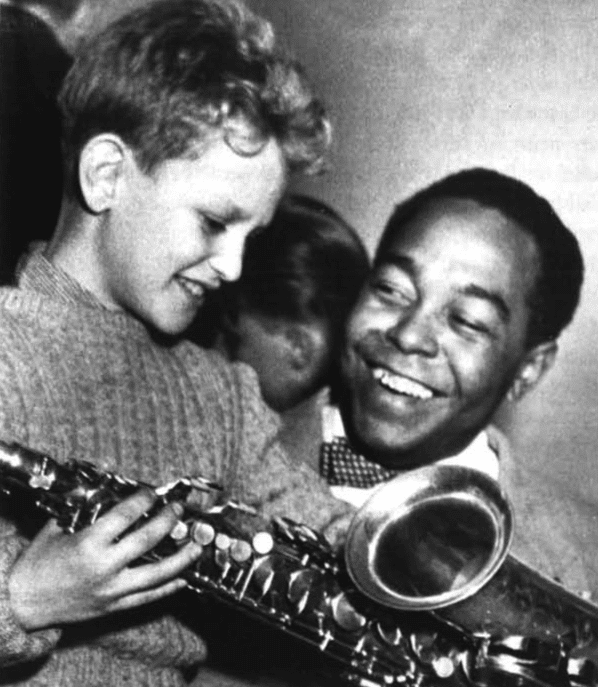
The photo has since become one of the most beloved images of Parker. Often we see him mid-solo, eyes closed, face tense with focus. Here, he is smiling warmly, relaxed, even playful. It captures a side of Parker that audiences rarely witnessed publicly: the human being behind the genius.
For Schultz, the encounter became a cherished childhood memory. For jazz historians, the picture stands as evidence of the unusually calm and generous spirit Parker carried during this period.
The Stockholm Concert: Bird in High Gear
The most substantial musical document from the tour comes from a concert recorded at Stockholm’s Konserthuset on 22 November 1950. Captured by Swedish radio, the performance reveals Parker at full creative strength: focused, fluid and inventive, playing with clarity and confidence.
Supported by Swedish musicians including Rolf Ericson, Gösta Theselius and others, Parker sounded both relaxed and energised. While the local rhythm sections naturally approached the bebop repertoire with their own phrasing and feel, their discipline and respect for the music allowed Parker to stretch out freely.
These recordings are often recommended to listeners exploring Parker’s later years. They show him playing with a balance of brilliance and calm that was increasingly rare.
The Side of Bird the World Rarely Saw
What makes the 1950 tour compelling is not only the music but also the contrast it represents. Before and after this period, Parker’s life was defined by turbulence — hospitalisations, breakdowns, financial pressure and the relentless impact of addiction. But in Sweden, he appeared lighter. He laughed more. He engaged with people. He held conversations without tension. He posed for photographs with fans.
It was not a permanent transformation. The struggles would return soon after he left Scandinavia, and the final years of his life would be among his most difficult. But for those who encountered him in 1950, Parker was not only a genius — he was present, warm and connected.
A Legacy Preserved in Tape and Memory
The tour left behind only a handful of recordings and a small number of photographs, hardly what one might expect for such a key figure. But the fragments that exist are precious. They show Charlie Parker at a rare moment when the weight of his life seemed to ease and the joy of performing was clearly visible.
The Gävle photograph offers a glimpse of the man.
The Stockholm recordings offer the sound of the moment.
Together, they document one of the most quietly beautiful chapters in the Bird story — a brief moment of light that still glows more than seven decades later.