

The vibraphone does not dominate a room in the way a trumpet or tenor saxophone might.
In the hands of Bobby Hutcherson, however, it radiated outward — metallic yet warm, capable of sharp attack and sustained shimmer. He could let a note ring into silence or punctuate a phrase with clipped precision. The instrument became both melodic voice and harmonic field.
Across the span of Bobby Hutcherson songs, what emerges is balance. His compositions often rest on lyrical cores, yet the harmonic undercurrents remain exploratory. Even at their most abstract, the melodies rarely disappear.
From Los Angeles Roots to Blue Note Innovation
Born in Los Angeles in 1941, Hutcherson came of age as West Coast jazz expanded beyond cool-school boundaries. By the early 1960s, his move to New York placed him inside the most forward-thinking Blue Note sessions of the era, collaborating with artists such as Eric Dolphy and Jackie McLean.
His own recordings soon followed. What distinguished them was compositional clarity. Rather than treating the vibraphone solely as texture, Hutcherson wrote pieces that gave it architectural weight. The songs below trace that evolution.
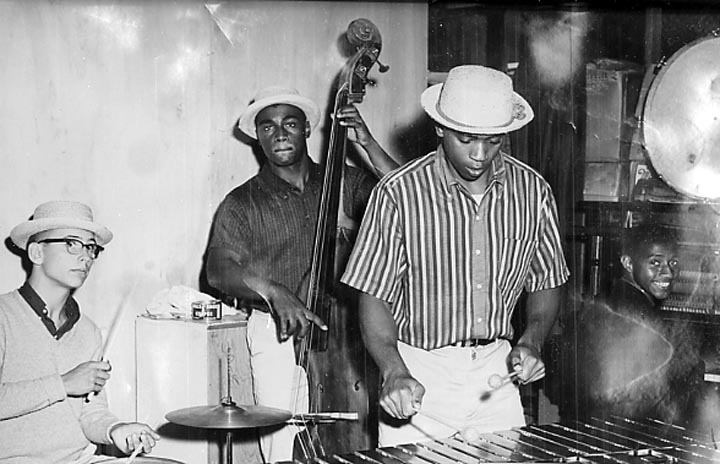
“Little B’s Poem” (1965)
Released on Components in 1965, “Little B’s Poem” remains one of Hutcherson’s most enduring compositions. Built around a gently ascending motif, the piece unfolds with quiet insistence. The rhythm section maintains steady motion while the vibraphone lines float above.
The melody feels simple at first hearing, yet its repetition gradually reveals subtle harmonic shifts. Among Bobby Hutcherson songs, this stands as a defining statement of lyrical modernism.
“Dialogue” (1965)
Appearing on the album of the same name, “Dialogue” captures the mid-1960s Blue Note spirit of exploration. The composition alternates between open improvisational passages and tightly structured ensemble lines.
The vibraphone tone cuts cleanly through shifting harmonic terrain. Rather than overpowering the ensemble, Hutcherson integrates into it, shaping phrases that interlock with horns and rhythm.
“Herzog” (1966)
From Stick-Up! (released 1966), “Herzog” reflects Hutcherson’s capacity to balance rhythmic drive with melodic contour. The tempo moves briskly, but the lines remain fluid.
The composition’s angular intervals create tension without sacrificing coherence. The piece demonstrates how forward motion and lyricism can coexist inside a hard bop framework.
“Oblique” (1967)
Issued in 1967, Oblique contains one of Hutcherson’s most harmonically layered works. The title track unfolds with a slightly darker tone, supported by rich harmonic textures.
Rather than foregrounding virtuosity, Hutcherson allows the melody to emerge gradually. Sustained notes resonate against piano voicings, creating depth without density.
“Isn’t This My Sound Around Me?” (1968)
From Total Eclipse (1968), this composition highlights his expanding structural imagination. The theme begins with a fragmented motif that resolves into broader harmonic movement.
The rhythm section navigates shifting meters and accents, while Hutcherson’s vibraphone lines glide across them with poised articulation.
“Ummh” (1970)
Released on San Francisco (1971 release; recorded 1970), “Ummh” leans toward funk-inflected groove. Electric textures enter the frame, and the rhythmic foundation thickens.
Hutcherson adapts without abandoning clarity. The vibraphone retains brightness while aligning more directly with groove-oriented phrasing. The shift feels evolutionary rather than abrupt.
“Montara” (1975)
The title track from Montara (1975) marked a different direction. Latin-tinged rhythms and expansive textures define the arrangement. The melody flows in long arcs, allowing the vibraphone to shimmer within a broader sonic landscape.
This recording expanded his audience while maintaining compositional discipline. It remains one of the most widely recognized Bobby Hutcherson songs.
“Highway One” (1979)
Drawn from the album of the same name (1979), this piece reflects a maturing tonal warmth. The tempo relaxes slightly, and phrasing becomes more spacious.
Rather than emphasizing abstraction, Hutcherson leans into melodic accessibility. The harmonic language remains sophisticated, but the emotional tone feels settled.
“My Joy” (1988)
From Cruisin’ the Bird (1988), “My Joy” shows Hutcherson reconnecting with acoustic jazz clarity. The vibraphone lines feel lighter, yet still purposeful. Interaction with the rhythm section becomes more conversational.
Improvisations stretch gently without losing center.
A Listening Path Through Bobby Hutcherson Songs
For listeners exploring his compositional range:
- “Little B’s Poem” (1965) — lyrical Blue Note breakthrough
- “Dialogue” (1965) — structured exploration
- “Herzog” (1966) — rhythmic drive and contour
- “Oblique” (1967) — harmonic layering
- “Ummh” (1971 release) — groove expansion
- “Montara” (1975) — Latin-inflected breadth
- “Highway One” (1979) — mature accessibility
This sequence traces a steady widening of texture without loss of melodic core.
Final Thoughts
Bobby Hutcherson’s compositions rarely announce their complexity loudly. Instead, they reveal it gradually — through repetition, resonance, and harmonic shading. The vibraphone becomes both voice and atmosphere, capable of clarity without sharpness.
Across decades, the defining quality remains proportion. Even as styles shifted from hard bop to funk-influenced textures and back toward acoustic refinement, the balance held.
In that equilibrium lies the lasting power of Bobby Hutcherson songs — melodic, exploratory, and quietly assured.