

Art Blakey’s impact on modern jazz is hard to exaggerate.
A volcanic drummer and tireless bandleader, he didn’t just define hard bop—he built a pipeline of talent that shaped jazz for generations.
There’s a famous story that he was forced at gunpoint to give up piano so Erroll Garner could take his seat. Blakey told the tale in different ways over the years, and historians remain sceptical. The truth is less important than what followed: by the mid‑1940s, Blakey was already one of the most commanding drummers in the music.
Born on 11 October 1919, he came up through Fletcher Henderson’s orchestra before joining Billy Eckstine’s forward‑looking big band. Between 1944 and 1947, he was at the centre of the bebop revolution, playing alongside Miles Davis, Charlie Parker, Dizzy Gillespie, Fats Navarro, and Dexter Gordon. Max Roach later remarked on Blakey’s ability to coordinate all four limbs independently—something that was still rare at the time.
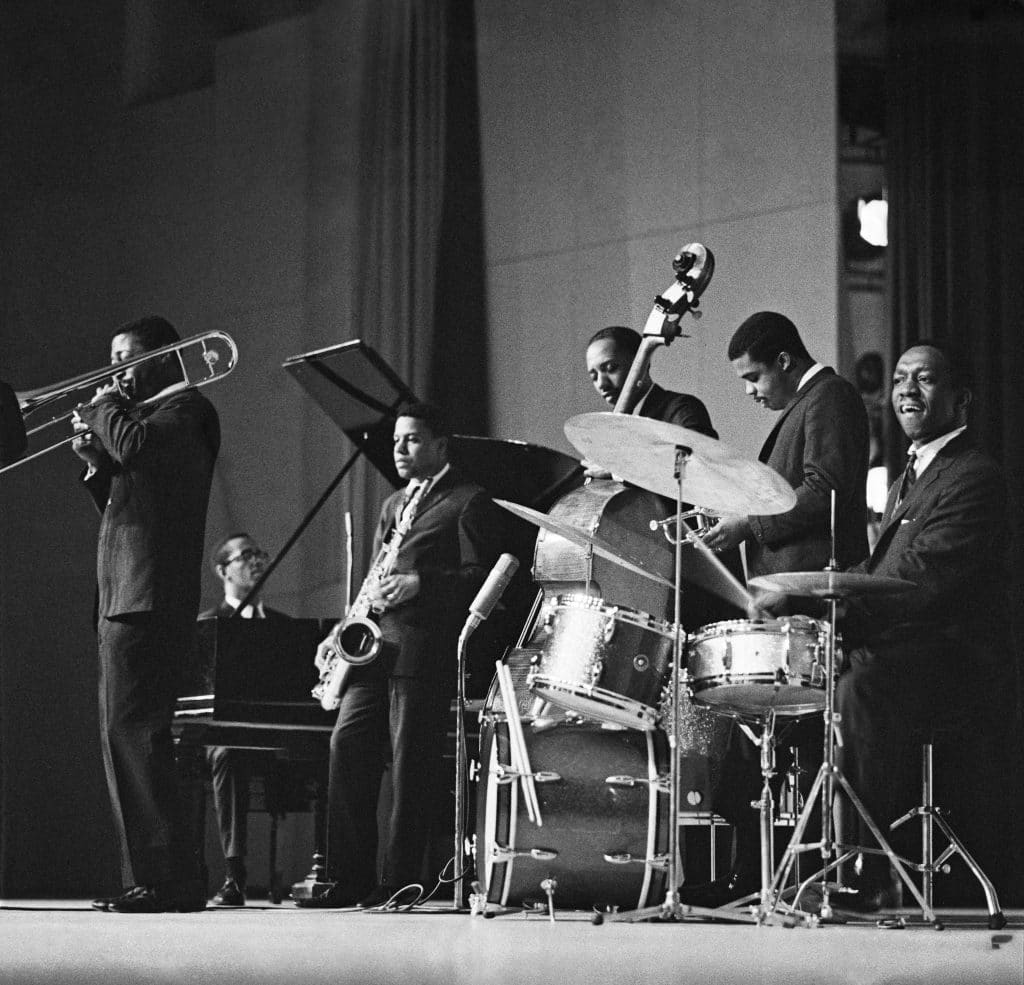
By the 1950s, Blakey was leading his own groups. When pianist Horace Silver and Blakey co‑founded The Jazz Messengers in 1954, the name stuck. After Silver departed, Blakey kept it—and for more than three decades, the Messengers became a proving ground for young musicians. Wynton and Branford Marsalis, Terence Blanchard, Mulgrew Miller, Donald Harrison, and many others passed through the band, learning the craft on the bandstand.
Here are some of the Art Blakey tracks that define his sound and his era.
Essential Art Blakey Songs
“In Walked Bud” – Art Blakey’s Jazz Messengers with Thelonious Monk (1957)
Blakey and Monk go back to the late 1940s Blue Note sessions, and this meeting is electric. The piano‑drum exchanges are tense, playful, and completely in sync.
“Moanin’” – Moanin’ (1958)
Bobby Timmons’ gospel‑soaked anthem became Blakey’s calling card. Built on call‑and‑response and deep blues feeling, it helped define the hard‑bop sound and became a jazz standard almost overnight.
“Along Came Betty” – Moanin’ (1958)
Benny Golson’s elegant tune showcases one of the Messengers’ classic line‑ups, with Lee Morgan and Golson delivering understated, lyrical solos over Blakey’s buoyant swing.
“Blues March” – Moanin’ (1958)
Inspired by New Orleans marching bands, this Golson composition turns parade rhythms into modern jazz. Blakey keeps it moving without ever letting it feel stiff.
“The Drum Thunder Suite” – Moanin’ (1958)
A three‑movement showcase written for Blakey’s mallet work. Dramatic openings, Latin‑tinged passages, and a funky finale make this a masterclass in dynamics and texture.
“I Remember Clifford” – 1958 Paris Olympia (1958)
Golson’s elegy for Clifford Brown is one of jazz’s most moving ballads. Lee Morgan’s trumpet and Blakey’s sensitive accompaniment make this live version especially poignant.
“Dat Dere” – The Big Beat (1960)
Another Bobby Timmons classic, recorded multiple times in rapid succession in 1960. Wayne Shorter’s tenor solo marks the beginning of his crucial tenure with the Messengers.
“Lester Left Town” – The Big Beat (1960)
Wayne Shorter’s tribute to Lester Young captures Pres’s cool elegance without imitation. Blakey’s drumming is crisp, supportive, and perfectly judged.
“Kozo’s Waltz” – A Night in Tunisia (1960)
Lee Morgan’s graceful waltz features inventive drum introductions and shows how Blakey could drive complex forms without overwhelming the band.
“One by One” – Ugetsu (1963)
Shorter’s concise composition suits the Messengers perfectly, with Freddie Hubbard, Curtis Fuller, Cedar Walton, and Jymie Merritt forming one of the great hard‑bop line‑ups.
Art Blakey’s Legacy
Art Blakey died on 16 October 1990, but his influence still runs through modern jazz. He wasn’t known as a prolific composer, yet his bands produced an astonishing catalogue of standards—thanks largely to composers like Golson, Shorter, Timmons, and Morgan passing through his ranks.
More than any single record, Blakey’s greatest achievement was The Jazz Messengers themselves. They were a living school of jazz, where young musicians learned to swing, write, and lead under real‑world pressure. Much of hard bop’s sound—and a large part of jazz’s modern lineage—runs directly through his bands.
Listen today and Blakey’s drumming still feels urgent and physical. The press rolls, the ride cymbal, the explosive crescendos—they all push the music forward with joy and conviction. Few musicians shaped jazz so directly, and fewer still did so with such generosity.