

Anita O’Day never fitted comfortably into the usual categories for jazz singers.
She wasn’t a torch singer. She didn’t trade on glamour. She had little interest in vulnerability as performance, or in occupying the traditional role of a “front person.”
What she offered instead was rarer: rhythmic authority, sharp musical judgement, and a way of phrasing that often sounded closer to a horn player than a vocalist.
That difference was audible from the start.
O’Day built her career on timing, intelligence, and independence. She treated songs as material to be shaped rather than vessels for emotional display, and she wanted to be judged as a musician, not a personality.
Her albums reflect that outlook. They are rarely sentimental. Rarely decorative. They are practical, focused, and grounded in swing.
This is a catalogue shaped by craft rather than image.
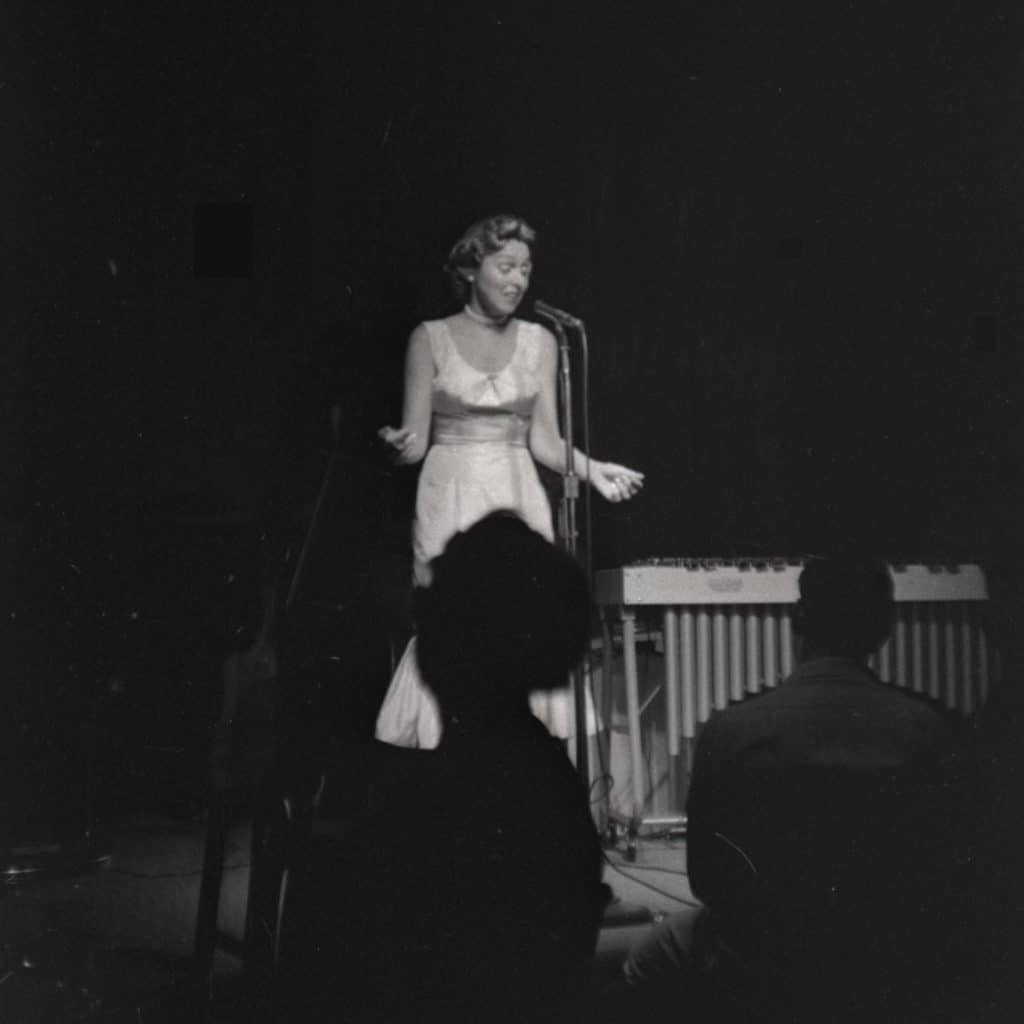
Learning to Swing First: Big Bands and Discipline
O’Day learned her trade in working bands, not studios or conservatoires.
In the late 1930s and early 1940s, she worked with major swing orchestras, most notably Gene Krupa’s and Stan Kenton’s. These were demanding environments. Singers had to project clearly, fit tightly inside arrangements, and stay rhythmically secure amid powerful sections.
She adapted fast.
Rather than floating above the band, O’Day placed herself inside it. She absorbed the rhythmic language of drummers and horn players and learned to phrase in direct relationship to them. That grounding in swing would remain central to her style for the rest of her career.
It also shaped her mindset. She thought like a band musician. Time, balance, and ensemble feel mattered more than theatrical display.
That perspective set her apart.
Establishing Her Voice: Anita
One of the clearest early statements of O’Day as a solo artist is Anita.
Recorded in 1955 and released the following year, the album places her in a small‑group setting that suits her perfectly. The arrangements leave space without becoming loose, giving her room to play rhythmically while maintaining shape.
Her control is immediately apparent.
She places phrases with precision. She reshapes melodies without distorting them. Articulation and timing do the expressive work — not volume, not vibrato.
There’s also a notable lack of self‑consciousness. O’Day isn’t projecting an image. She’s simply doing the job: interpreting songs clearly, intelligently, and with purpose.
For many listeners, this is where her solo identity comes into focus.
The Signature Statement: Pick Yourself Up with Anita O’Day
If one studio album captures O’Day at full strength, it’s Pick Yourself Up with Anita O’Day.
Recorded in 1956 and released in 1957, it brings together all her defining qualities: rhythmic acuity, musical intelligence, and relaxed authority. The repertoire leans on standards, but nothing feels routine.
What stands out over time is her sense of proportion.
She never overloads a phrase. She never stretches a song beyond what it can support. She understands exactly how much variation a melody can take before it loses its shape.
The result is singing that feels natural rather than mannered.
This album is often recommended as a starting point because it presents O’Day without gimmicks or detours — just clarity, swing, and judgement.
Live Presence: Anita O’Day at Newport
O’Day’s reputation rests in part on how she handled live performance.
That side of her artistry is captured vividly on Anita O’Day at Newport, recorded at the 1958 Newport Jazz Festival. It’s a high‑pressure setting, in front of a large audience and alongside leading instrumentalists of the era.
She thrives.
Rather than playing safe, she leans into the moment. Her phrasing grows bolder, her rhythmic placement more adventurous. She interacts actively with the band, responding rather than reacting.
What you hear is confidence built on preparation.
She isn’t improvising recklessly. She’s making informed decisions in real time, grounded in deep familiarity with both material and musicians.
This album explains why instrumentalists held her in such high regard.
Working with Arrangers: All the Sad Young Men
O’Day also had a sharp instinct for collaborators.
All the Sad Young Men, recorded in 1961, places her within richer, more elaborate arrangements than her usual small‑group settings. The textures are denser, the emotional range broader.
She adapts effortlessly.
Rather than being submerged by orchestration, she adjusts her phrasing and tone to fit the environment, maintaining clarity and rhythmic focus throughout.
The album highlights her flexibility. She could move between intimate club contexts and more complex arrangements without losing her musical identity.
Ballads Without Sentimentality: Trav’lin’ Light
O’Day is often labelled an up‑tempo specialist, which underplays her command of slower material.
That ability comes into focus on Trav’lin’ Light, recorded in 1960. The tempos are relaxed, the mood restrained, the emphasis squarely on nuance.
Her approach is marked by emotional discipline.
She resists exaggeration. She avoids dramatic dynamics. Instead, she relies on timing, shading, and small shifts in articulation to shape meaning.
The result is intimacy without indulgence.
This album is key to understanding how seriously she thought about expression — even when vulnerability was implied rather than stated.
Resilience and Late Career: Indestructible!
After serious personal and health challenges in the 1960s, O’Day returned to recording with renewed focus.
Indestructible!, released in 1976, documents that resilience. Her voice is darker and rougher than in her youth, but her rhythmic authority and musical judgement remain intact.
She adapts intelligently.
Rather than chasing earlier sounds, she works with the instrument she has. She leans on phrasing and timing, choosing material that suits her range and experience.
It’s a record about adjustment — and professionalism.
Rhythm, Time, and Musical Values
More than almost any singer of her generation, O’Day was defined by rhythm.
She treated time as something to engage with, not simply follow. She could sit behind the beat, lean forward, or lock directly into the groove depending on context.
That flexibility made her invaluable to bands.
She didn’t disrupt ensemble balance. She strengthened it.
Tone was secondary. She didn’t possess a conventionally “pretty” voice, and she never tried to cultivate one. Clarity, articulation, and swing mattered more.
Underlying everything was judgement — knowing when to simplify, when to vary, and when to leave things alone.
Anita O’Day as an Interpreter
O’Day rarely wrote her own material, but she approached interpretation as a creative act.
She paid close attention to lyrics, harmonic context, and form. Her versions of songs often differ subtly but decisively from earlier readings.
She avoided underlining emotion.
Instead, she trusted listeners to hear it. That restraint gives her performances durability rather than period flavour.
Across her catalogue, the philosophy remains consistent: respect the song, understand its structure, then reshape it quietly from the inside.
Finding Your Way In
For new listeners, it helps to approach O’Day’s catalogue from multiple angles.
Anita and Pick Yourself Up with Anita O’Day show her core studio voice.
Anita O’Day at Newport captures her live authority.
All the Sad Young Men highlights her adaptability to larger arrangements.
Trav’lin’ Light reveals her ballad discipline.
Indestructible! documents late‑career resilience.
Together, they form a coherent picture of how she worked — and how she evolved.
Anita O’Day’s Legacy
Anita O’Day matters because she expanded the idea of what a jazz singer could be.
She showed that vocalists could function as full rhythmic partners within bands. She demonstrated that technical polish wasn’t a prerequisite for depth. She proved that independence and professionalism could coexist.
She took the music seriously — without taking herself too seriously.
Listen across her albums and what stands out isn’t attitude or image, but craft.
That craft is the foundation of her lasting place in jazz history.