

These are 10 Charles Lloyd albums, from Forest Flower to The Sky Will Still Be There Tomorrow, with the story behind each one and a track to start with. They count down to the record most people hear first.
On 27 January 1967, Lloyd took a jazz quartet with a 21-year-old Keith Jarrett on piano into the Fillmore Auditorium in San Francisco, the ballroom of the psychedelic rock bands. The tapes became an album, and the band kept sharing bills with the new rock groups. Miles Davis didn’t play the Fillmore East until 1970.
And at the end, the week in May 1967 when Soviet officials kept the quartet waiting until the last night of a jazz festival in Tallinn before letting them play.

10. Trios: Chapel (2022)
Lloyd chose this line-up because of the room. The trio with guitarist Bill Frisell and bassist Thomas Morgan is named after its first concert, in December 2018 at Coates Chapel in San Antonio, Texas, where Lloyd felt the acoustics would not take drums or percussion.
Blue Note released the recording of that night in June 2022 as the first of three Trios albums. Ocean (with Gerald Clayton and Anthony Wilson) and Sacred Thread (with Julian Lage and Zakir Hussain) followed before the year was out, and DownBeat named Lloyd its 2023 Artist of the Year on the strength of the series.
With no drummer, Morgan’s bass keeps the time and Frisell’s guitar fills the space a pianist would. The set opens with Billy Strayhorn’s ballad “Blood Count” and includes “Song My Lady Sings”, a Lloyd tune from 1965 heard here at a much slower burn.
Start with: “Blood Count” · Trios: Chapel on Amazon

9. Wild Man Dance (2015)
The Polish festival Jazztopad commissioned this six-part suite for its tenth anniversary, and Lloyd premiered it in Wrocław in November 2013. “I was interested in the geographical locale of Wroclaw,” he told Blue Note. “What was the natural environment of the region?”
The first movement, “Flying Over the Odra Valley”, is named after the river that runs through the city.
Alongside pianist Gerald Clayton, bassist Joe Sanders and drummer Gerald Cleaver, he added two instruments rarely heard in a jazz band: the Greek lyra, a small bowed string instrument played by Sokratis Sinopoulos, and the Hungarian cimbalom, a hammered dulcimer played by Miklós Lukács.
Released in April 2015, it was his first album after signing to Blue Note that January, three decades after A Night in Copenhagen (No. 8). Listen for the cimbalom shimmering under the tenor; it gives the suite an Eastern European colour no American rhythm section could. “I’m a blues man on a spiritual journey,” Lloyd said at the time.
Start with: “Flying Over the Odra Valley” · Wild Man Dance on Amazon

8. A Night in Copenhagen (1985)
By the 1970s Lloyd had largely walked away from the jazz world. He shared an interest in Transcendental Meditation with the Beach Boys, played flute on their 1971 album Surf’s Up and joined their touring band in 1977, as Matt Leskovic recounts in All About Jazz.
Then, in 1981, a teenage French pianist came to see him in California. Michel Petrucciani was 18, and hearing him play persuaded Lloyd to tour again. Their quartet played Montreux in July 1982, and on 11 July 1983 it was taped at the Copenhagen Jazz Festival with Palle Danielsson on bass and Woody “Sonship” Theus on drums. Blue Note released it in 1985.
Bobby McFerrin sings on two tracks of the CD edition, but the reason to hear it is Petrucciani, aged 20, pushing a leader more than twice his age. Once the touring was over, Lloyd went back to his home at Big Sur for most of the decade.
Start with: “Lotus Land” · A Night in Copenhagen on Amazon

7. Rabo de Nube (2008)
ECM released this live set on 7 March 2008, timed for Lloyd’s 70th birthday that month. It was recorded at Theater Basel in Switzerland in April 2007 with what Lloyd called his New Quartet: Jason Moran on piano, Reuben Rogers on bass and Eric Harland on drums. It was the first ECM record for both Moran and Rogers.
The title track, which closes the album, is by the Cuban singer-songwriter Silvio Rodríguez; the phrase means “tail of a cloud”. Lloyd had first recorded it six years earlier on Lift Every Voice (No. 4).
What you’ll notice is Moran. ECM’s own notes hear Thelonious Monk and Bud Powell in his percussive attack, and Lloyd answers with a nod of his own, “La Colline de Monk”. The 14-minute “Booker’s Garden” is a tribute to his Memphis friend Booker Little, a trumpeter who died in 1961 aged 23. Lloyd recorded it again for No. 3.
Start with: “Booker’s Garden” · Rabo de Nube on Amazon

6. Vanished Gardens (2018)
Lloyd first came across Lucinda Williams around the time of her 1998 album Car Wheels on a Gravel Road. She first came to hear him at a concert by his band The Marvels at the Lobero Theatre in Santa Barbara. “It was our first meeting and I sensed a deep Southern crossroads connection,” he told Relix.
Blue Note released the result in June 2018, co-produced with Don Was. Williams sings on five of the ten tracks, backed by The Marvels: Bill Frisell on guitar, Greg Leisz on pedal steel and dobro, Reuben Rogers on bass and Eric Harland on drums.
This is the one to play a friend who likes Americana more than jazz. Leisz’s pedal steel sits under Williams’s worn voice on her own songs, including “Dust”, “Ventura” and “Unsuffer Me”, and Lloyd’s tenor answers her lines. The instrumentals in between include a slow reading of Monk’s “Monk’s Mood”.
Start with: “Dust” · Vanished Gardens on Amazon
5. Canto (1997)
In 1986 Lloyd nearly died from a serious illness. Two years later he put a new quartet together around the Swedish pianist Bobo Stenson, and in July 1989 he made Fish Out of Water for ECM in Oslo, the first of a run of albums for Manfred Eicher’s label.
Canto, recorded at Rainbow Studio in Oslo in December 1996 and released in May 1997, was his fifth ECM album. Stenson is still at the piano, with Anders Jormin on bass and Billy Hart on drums. ECM quotes Stereophile’s verdict: “The most important tenor development of the 1990s has been the return of Charles Lloyd.”
The pieces are long and unhurried. “Tales of Rumi”, named after the Sufi poet, runs nearly 17 minutes, and Lloyd also plays Tibetan oboe. “We play for those miraculous moments when the music opens up and you know you’re home,” he said of this band.
Start with: “Tales of Rumi” · Canto on Amazon

4. Lift Every Voice (2002)
Lloyd was booked to play the Blue Note club in New York in the week of 11 September 2001. The shows were postponed after the attacks, and later that week he and the club decided to go ahead.
The double album he recorded in Los Angeles in January and February 2002 grew out of that week. Geri Allen plays piano, John Abercrombie guitar, Billy Hart drums, and Marc Johnson and Larry Grenadier share the bass chair. ECM released it in October 2002.
The repertoire is mostly songs people already carry with them: the spirituals “Go Down Moses”, “Deep River” and “Wayfaring Stranger”, “Amazing Grace”, Marvin Gaye’s “What’s Going On”, and the hymn by James Weldon Johnson and J. Rosamond Johnson often called the Black national anthem, “Lift Every Voice and Sing”. Next to Lloyd’s 15-minute original “Hymn to the Mother”, they make a two-disc set built for listening straight through.
Start with: “Lift Every Voice and Sing” · Lift Every Voice on Amazon

3. The Sky Will Still Be There Tomorrow (2024)
Blue Note released this double album on 15 March 2024, Lloyd’s 86th birthday. He had chosen the band in 2020, Jason Moran on piano, Larry Grenadier on bass and Brian Blade on drums, but schedules kept them apart until March 2023. They recorded at his home studio in Santa Barbara, then played a concert at the Lobero Theatre to mark his 85th birthday.
The title comes from a joke about his age. “So the sky is always, like, the closer I get to it, the Creator says, ‘Not yet, Charles,'” he told Spin.
There are 15 tracks, from the one-minute “Late Bloom” to the 15-minute “Sky Valley, Spirit of the Forest”, with new tunes written during lockdown alongside older ones such as “Booker’s Garden”. It reached No. 2 on the UK Jazz & Blues Albums chart, and DownBeat’s 2024 Critics Poll named it Album of the Year.
Start with: “Defiant, Tender Warrior” · The Sky Will Still Be There Tomorrow on Amazon

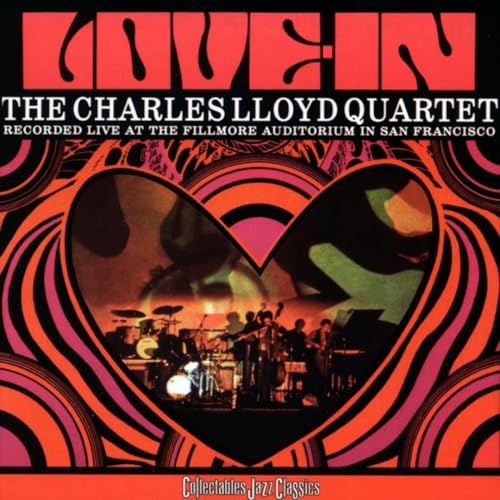
2. Love-In (1967)
This is the Fillmore concert from 27 January 1967. By then Ron McClure had replaced Cecil McBee on bass, alongside Jarrett and Jack DeJohnette, and Atlantic had the album out by the end of July.
San Francisco took to them. The promoter Chet Helms called them “the first psychedelic jazz group”, Chris May writes in All About Jazz, and they shared stages with the Grateful Dead, Janis Joplin and the Byrds. “It felt like the sky was the limit,” Lloyd told Graham Reid in 2010.
The record sounds like that room. There is a four-minute cover of the Beatles’ “Here, There and Everywhere”, recorded just five months after Revolver came out, Jarrett’s eight-minute “Sunday Morning”, and a closing medley, “Memphis Dues Again/Island Blues”, that takes Lloyd back to his home town.
Start with: “Love-In” · Love-In on Amazon
1. Forest Flower (1967)
On 18 September 1966, the Charles Lloyd Quartet played the Monterey Jazz Festival. The band had been together less than a year: Keith Jarrett was 21, Jack DeJohnette 24, and Cecil McBee was on bass. The producer George Avakian released the set on Atlantic in February 1967, with two studio tracks recorded in New York ten days before Monterey.
NPR calls it a million-seller. The Guardian’s Garth Cartwright goes further, calling it the first modern jazz album to sell more than a million copies in the US. Either way, it took Lloyd out of the jazz clubs and onto the rock circuit.
The two-part title piece is the reason: Lloyd’s own tune, split into “Sunrise” and “Sunset”, nearly 18 minutes between them, with Jarrett’s piano as much a lead voice as the tenor. Jarrett’s “Sorcery” and McBee’s “Song of Her” show how much the sidemen brought too.
Lloyd later said the success counted against him: “there seemed to be a consensus, at the time, that if I was experiencing such a degree of success, something must be wrong with the artistic expression.”
Start with: “Forest Flower: Sunrise” · Forest Flower on Amazon

Days and Nights Waiting in Tallinn
In May 1967 the quartet, with Ron McClure now on bass, was invited to the Tallinn jazz festival in Estonia, then part of the Soviet Union. McClure told the story in his memoir, which Lewis Porter has excerpted. They flew from New York to Helsinki on 8 May, Jarrett’s 22nd birthday, and took the ferry across the Gulf of Finland two days later.
On the Friday they turned up to play and were asked to leave. Officials finally let them on stage on Sunday 14 May, the last day of the festival, at the Kalev Sports Hall. According to McClure, the crowd got so excited that KGB men walked the aisles telling people to sit down, and a string orchestra played “Laura” to calm things.
Jarrett had used the wait. His new tune “Days and Nights Waiting” opens the album of that set, Charles Lloyd in the Soviet Union, which Atlantic released in 1970. The quartet went on to play in Leningrad and Moscow before flying home.
Those are 10 Charles Lloyd albums, from Forest Flower to The Sky Will Still Be There Tomorrow, across nearly six decades and three labels: Atlantic, ECM and Blue Note.
Two of the young men from that Tallinn stage went on to their own careers: start with our 10 essential Keith Jarrett albums and our pick of Jack DeJohnette albums. Lloyd’s long run with Manfred Eicher’s label sits in a bigger story, told in ECM Records: 10 albums that changed the landscape of jazz. And the 18-year-old who talked him out of retirement had a story all of his own: read our Michel Petrucciani biography.
Note: As an Amazon Associate we earn from qualifying purchases.
Which Charles Lloyd quartet would you most like to have heard live: the 1960s band with Jarrett and DeJohnette, the Petrucciani quartet of the early 1980s, or the band with Jason Moran?
