

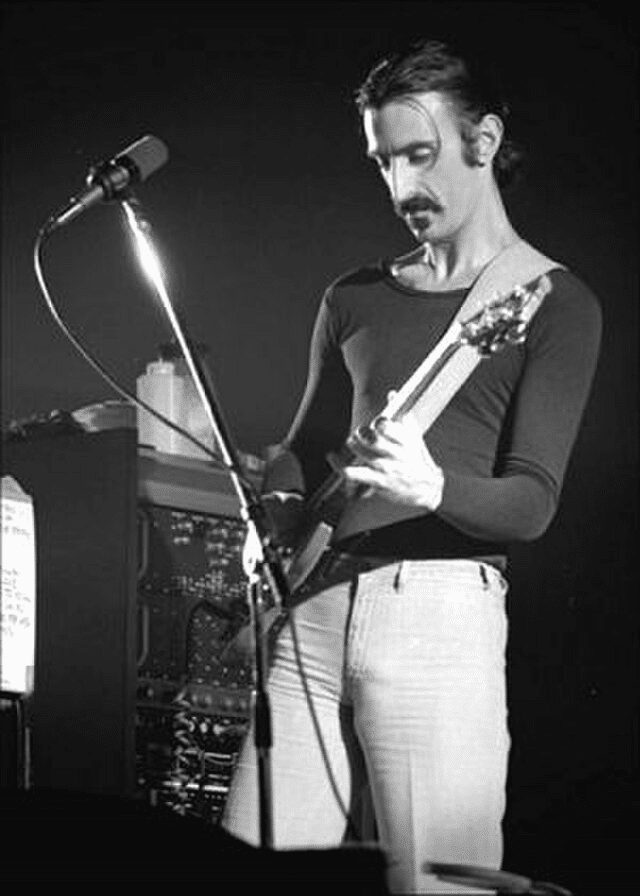
By the early 1970s, guitarist Frank Zappa had become one of the most unusual figures in American music. On one hand, he could sell out concert halls and place albums in the charts. On the other, he was writing orchestral scores, experimenting with odd time signatures, and releasing records that seemed to take pleasure in baffling casual listeners.
Nearly thirty years after his death in 1993, Zappa remains a misunderstood figure. To some, he is remembered mainly for novelty hits and outrageous humour. To others — particularly musicians — he stands as one of the most serious and disciplined composers to emerge from rock music.
Self-taught, fiercely independent, and resistant to categorisation, Zappa followed a musical path that was rarely straightforward. His work moved freely between jazz, rock, classical modernism, satire, and social commentary, often within the same album.
In this guide, we explore some of Frank Zappa’s most important songs — recordings that reveal the depth, ambition, and restless intelligence behind one of popular music’s most distinctive catalogues.
Early Experiments and Satire (1966–1968)
Brown Shoes Don’t Make It
Absolutely Free (1967)
From the second album by Frank Zappa and the Mothers of Invention, this seven-minute suite captures his early approach perfectly. Shifting abruptly between musical styles, it combines doo-wop, rock, orchestral passages, and spoken satire.
Lyrically, it skewers American politics and middle-class hypocrisy with blunt humour. Musically, it shows Zappa’s early fascination with collage-like structures — a technique he would return to throughout his career.
For many listeners, this track marks the point where Zappa’s ambitions first became impossible to ignore.
Funk, Fusion, and Musical Precision (1973–1975)
Montana
Over-Nite Sensation (1973)
Compared with his late-1960s work, Montana is relatively accessible. Built around a relaxed funk groove, it features Tina Turner and the Ikettes on backing vocals and showcases Zappa’s gift for combining humour with disciplined musicianship.
The real highlights, however, are Ralph Humphrey’s precise drumming, Tom Fowler’s supple bass playing, and Zappa’s extended guitar solo — melodic, controlled, and quietly virtuosic.
It is one of the clearest examples of how he could make complex music feel inviting.
Don’t Eat the Yellow Snow
Apostrophe (’) (1974)
Part of a larger narrative suite, this playful track became one of Zappa’s biggest commercial successes and helped drive Apostrophe to number ten on the Billboard chart — his highest-charting album.
Blending surreal humour with jazz-rock fusion, it represents perhaps the closest Zappa ever came to mainstream pop success, without compromising his musical personality.
Cosmik Debris
Apostrophe (’) (1974)
Built around a slow, steady groove, Cosmik Debris balances satire with strong melodic writing. Zappa delivers the lyrics in a semi-spoken style, supported by tight rhythm section work and restrained backing vocals.
His guitar solo, brief but focused, fits the album’s more radio-friendly approach while retaining his distinctive tone.
Inca Roads
One Size Fits All (1975)
For many musicians, Inca Roads remains one of Zappa’s most impressive achievements.
Running over eight minutes, the piece moves through shifting time signatures, abrupt stylistic changes, and intricate ensemble passages. Ruth Underwood’s marimba and vibraphone work adds a unique timbral layer, while the band navigates the complex arrangement with remarkable precision.
The track demonstrates how Zappa could fuse jazz complexity with rock energy without diluting either.
Commercial Peak and Social Commentary (1979–1982)
Dancin’ Fool
Sheik Yerbouti (1979)
Zappa’s biggest-selling album arrived at the height of the disco era, and Dancin’ Fool reflects his characteristic response: affectionate parody mixed with sharp observation.
The song shifts between disco rhythms, rock textures, and spoken asides, capturing both the sound and social atmosphere of late-1970s club culture.
It remains one of his most recognisable recordings.
Joe’s Garage
Joe’s Garage Act I (1979)
The opening track of Zappa’s three-part rock opera introduces the character of Joe, a young musician navigating censorship, commercial pressure, and artistic frustration.
Across the trilogy, Zappa uses satire to explore American politics, moral panic, and the music industry itself. Despite the explicit humour, the underlying musical writing is consistently strong.
Joe’s Garage stands as one of his most ambitious long-form projects.
Valley Girl
Ship Arriving Too Late to Save a Drowning Witch (1982)
Zappa’s only Top 40 hit grew out of a guitar riff developed during rehearsals. His daughter Moon contributed the now-famous “Valley girl” vocal character, inspired by Southern California teenage slang.
Behind the novelty surface lies a tightly constructed rock song, built around disciplined ensemble playing and an ear for pop structure.
It remains one of the most enduring examples of his ability to blend satire with chart appeal.
Why Frank Zappa Still Matters Today
Looking back across Zappa’s catalogue, what stands out is his refusal to settle into a single musical identity. He resisted the idea of a “signature sound”, preferring constant reinvention and stylistic risk.
His influences ranged from Igor Stravinsky, Anton Webern, and Edgard Varèse to rhythm and blues, doo-wop, and bebop. Early training as a drummer shaped his lifelong interest in rhythm and unusual metres, while his admiration for modernist composers informed his approach to large-scale composition.
Although he never achieved the level of commercial success enjoyed by many of his contemporaries, he earned lasting respect among musicians. Today, his influence can be heard in progressive rock, jazz fusion, experimental music, and even comedy songwriting.
Few artists have moved so freely between genres without losing their identity.
Frequently Asked Questions About Frank Zappa
Was Frank Zappa classically trained?
No. He was largely self-taught, although he studied classical scores independently and later worked with professional orchestras.
Did Frank Zappa play jazz?
While he rarely worked within traditional jazz formats, his music drew heavily on jazz harmony, improvisation, and rhythmic complexity.
What was Frank Zappa’s biggest hit?
Valley Girl (1982) was his only Top 40 single in the United States.
How many albums did Zappa release?
During his lifetime, he released over 60 albums, with many more appearing posthumously.
Who influenced Frank Zappa most?
Key influences included Edgard Varèse, Igor Stravinsky, Johnny “Guitar” Watson, and early rhythm and blues.
Final Thoughts
Frank Zappa’s music is not always easy. It demands attention, patience, and curiosity. But for listeners willing to engage with it, the rewards are considerable.
Behind the satire and provocation lies a composer of rare discipline and imagination — one who treated popular music as a serious creative medium.
If you’re interested in other artists who blurred the boundaries between jazz, rock, and classical music, you may also enjoy our guides to Miles Davis’s electric period and Herbie Hancock’s fusion years.
Only 2 rock musicians have been voted into the Downbeat (Jazz) Hall of Fame: Frank Zappa (critics poll) and Jimi Hendrix (readers poll).