

Few jazz musicians covered as much musical ground as Chick Corea.
Over a career that stretched from the early 1960s to his death in 2021, he moved effortlessly between acoustic trio jazz, Latin music, fusion, modern classical composition, and electronic experimentation. Some listeners discovered him through Spain. Others through his work with Miles Davis. Others still through his intimate duo recordings with Gary Burton.
This guide focuses on ten recordings that best capture that range — not just his most famous tunes, but the pieces that reveal how he thought about rhythm, harmony, and improvisation across six decades.
If you are new to Corea’s music, these tracks offer an ideal starting point. If you know the catalogue well, they trace the arc of a restless and unusually curious career.
First though, the quick a quick introduction to Chick Corea
Born Armando Anthony Corea in Chelsea, Massachusetts, on 12 June 1941, Chick Corea began playing piano at the age of four. As a teenager, he studied classical piano with Salvatore Sullo, developing strong reading skills and a deep interest in composition.
At the same time, he became absorbed in bebop, particularly the playing of Dizzy Gillespie, Charlie Parker, Bud Powell, and Horace Silver.
After short periods at Columbia University and Juilliard — both cut short by professional opportunities — Corea entered New York’s working jazz scene in the early 1960s, performing with Blue Mitchell, Willie Bobo, Mongo Santamaría, and Stan Getz.
His breakthrough came later in the decade, when he joined Miles Davis’s electric bands, replacing Herbie Hancock and contributing to landmark albums such as In a Silent Way and Bitches Brew. The experience reshaped his approach to rhythm, texture, and group interaction.
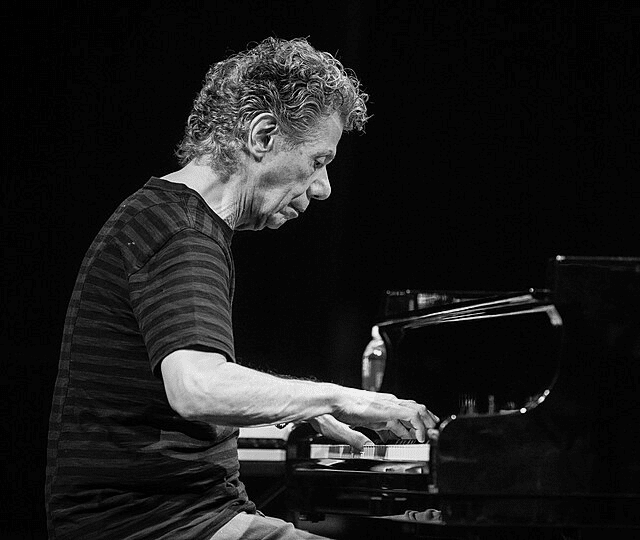
By the early 1970s, Corea had become one of jazz’s most influential bandleaders, most notably through Return to Forever, while continuing to develop parallel careers in acoustic and classical-influenced settings.
Here are 10 essential Chick Corea songs for fans old and new.
1. Tones for Joan’s Bones (1966)
From: Tones for Joan’s Bones
Recorded for Atlantic in 1966, this was Corea’s first album as a leader.
The title track highlights his early grounding in hard bop, with Woody Shaw and Joe Farrell on the front line. Yet the trio passages, featuring Steve Swallow and Joe Chambers, already point towards a more lyrical and flexible approach.
The opening unfolds quietly, with brushed drums and spacious phrasing, before settling into a relaxed swing. Corea’s solo is fluid and melodic, revealing a young pianist already searching for his own voice.
2. Now He Sings, Now He Sobs (1968)
From: Now He Sings, Now He Sobs
Often cited as one of the great piano trio recordings of the 1960s, this album pairs Corea with Miroslav Vitouš and Roy Haynes.
Much of the music is built from loose sketches rather than fixed compositions. The title track grows organically from a simple idea into a tightly connected group improvisation.
The trio’s balance of freedom and structure became a model for later generations, and it remains one of Chick Corea’s most influential albums.
3. Sometime Ago / La Fiesta (1972)
From: Return to Forever
This extended suite introduced the first major incarnation of Return to Forever, featuring Joe Farrell, Stanley Clarke, Airto Moreira, and Flora Purim.
“Sometime Ago” unfolds slowly, built around shimmering electric piano textures and Clarke’s expressive bass work. After several minutes, the music gradually coalesces into a clearly defined theme.
“La Fiesta” follows without pause, shifting into a bright, rhythmically driven celebration that became one of Corea’s signature compositions.
4. Crystal Silence (1973)
With Gary Burton
Recorded with vibraphonist Gary Burton, Crystal Silence marked the beginning of one of jazz’s most enduring duos.
The title track is built on delicate harmonic movement and careful dynamic control. Rather than competing for space, Burton and Corea weave around each other, leaving room for silence and resonance.
The recording set a new standard for duo interaction and remained a reference point throughout their long partnership.
5. Señor Mouse (1973)
With Gary Burton
From the same album, “Señor Mouse” shows the other side of the duo.
Driven by Corea’s insistent left-hand figure, the piece is playful, rhythmically sharp, and full of sudden turns. Burton’s mallet work dances around the piano lines with remarkable precision.
It captures the sense of humour and spontaneity that characterised many of Corea’s best performances.
6. Spain (1973)
From: Light as a Feather
“Spain” is arguably Corea’s most widely recognised composition.
Inspired by Joaquín Rodrigo’s Concierto de Aranjuez, the piece opens with a quotation from the classical work before launching into a fast-moving Latin-jazz groove.
The version recorded by Return to Forever in 1973 remains definitive, combining technical brilliance with an infectious sense of momentum. It has since become a standard across jazz and fusion repertoires.
7. 500 Miles High (1973)
From: Light as a Feather
With lyrics by Neville Potter and vocals by Flora Purim, “500 Miles High” occupies a more reflective space.
Joe Farrell’s tenor saxophone adds weight and warmth, while the rhythm section creates a floating, almost weightless feel.
The tune has been widely covered, both instrumentally and with vocals, and remains one of Corea’s most enduring ballads.
8. Armando’s Rumba (1976)
From: My Spanish Heart
Named after Corea’s given first name, “Armando’s Rumba” reflects his long-standing interest in Spanish and Latin music.
Built around handclaps, strings, and layered percussion, the piece combines classical orchestration with popular rhythms. Despite its complexity, it remains light on its feet and immediately engaging.
It also became a concert favourite, frequently reworked in later performances.
9. Quartet No. 2 (Parts 1 & 2) (1981)
From: Three Quartets
On Three Quartets, Corea explored the relationship between jazz and classical chamber music.
“Quartet No. 2” brings together Michael Brecker, Eddie Gomez, and Steve Gadd in a two-part structure inspired by both jazz quartet and string quartet traditions.
Part One, dedicated to Duke Ellington, emphasises lyricism and harmonic colour. Part Two, dedicated to John Coltrane, opens into extended improvisation, with particularly powerful solos from Corea and Brecker.
10. Children’s Song No. 6 (1983)
From: Children’s Songs
The Children’s Songs series reflects Corea’s interest in short, self-contained musical forms.
Often compared to Bartók’s Mikrokosmos, these pieces explore pentatonic scales, irregular metres, and gradual technical development.
No. 6 stands out for its simplicity and warmth, capturing a sense of innocence without becoming sentimental. It has since entered both jazz and classical recital repertoires.
Chick Corea’s Legacy: A Musician Without Borders
Throughout his career, Chick Corea resisted easy categorisation.
He was sometimes criticised for pursuing commercially successful projects alongside more abstract work. Yet this variety reflected a consistent belief: that curiosity mattered more than reputation.
He received more than 70 Grammy nominations and won 27 awards, but his influence extends far beyond statistics. Pianists from Herbie Hancock to Brad Mehldau have acknowledged his impact, while younger musicians continue to draw on his compositional models.
Many of his early pieces remained in his repertoire for decades, evolving through constant reinterpretation. That willingness to revisit, revise, and rethink may be his most enduring legacy.
More than any single style or period, Corea’s career stands as an example of what happens when technical mastery is matched by intellectual openness — and when a musician never stops asking what might come next.
Looking for more? Check out our guide to the greatest jazz pianists of all time.