

Jazz-rock and jazz fusion get used almost interchangeably, and the genre’s own critics have never fully agreed on its borders.
We may earn a commission if you buy through the Amazon links on this page.
Some of the records below were made by jazz musicians absorbing rock’s volume and rhythm section; others were made by rock musicians hiring jazz players for a session; a few, like Soft Machine’s contribution to Britain’s Canterbury scene, grew out of a regional tradition that owes as much to psychedelia as to Miles Davis.
Several of these albums get claimed just as readily by progressive rock canon as by jazz canon, and that overlap is worth naming rather than smoothing over.
What follows are ten records, listed chronologically, that between them trace the genre from its late-1960s origins in guitar-and-organ power trios through its mid-1970s commercial peak and into the more contested territory at its edges.
Frank Zappa – Hot Rats (1969)
Recorded across three Los Angeles studios in the summer of 1969 using a custom 16-track recorder built specifically for the sessions, Hot Rats is, by Wikipedia’s own useful description, “an instrumental rock album played mostly by jazz musicians.”
Zappa’s core band included multi-instrumentalist Ian Underwood, violinists Jean-Luc Ponty and Don “Sugarcane” Harris, and a fifteen-year-old Shuggie Otis on bass, with Captain Beefheart contributing the sole vocal on “Willie the Pimp.”
Robert Christgau gave the record a lukewarm grade on release, but its reputation only grew, and it later appeared in 1001 Albums You Must Hear Before You Die. Ponty in particular used the record’s success to launch a major fusion career of his own over the following decade.

Tony Williams Lifetime – Emergency! (1969)
Recorded over two days in May 1969 and released that September as a double album, Emergency! paired drummer Tony Williams, fresh off five years in Miles Davis’s quintet, with guitarist John McLaughlin and organist Larry Young in a raw, distorted power-trio format closer to rock instrumentation than to any conventional jazz group.
An engineer more used to polished mainstream jazz sessions reportedly recorded the band carelessly, letting the tape distort in ways that ended up giving the record much of its abrasive character.
Robert Christgau called Williams “probably the best drummer in the world” and described the album as an extrapolation of free jazz’s rawest qualities and wah-wah rock guitar, and it’s frequently cited, alongside Davis’s own In a Silent Way, as a direct influence on Bitches Brew the following year.


Miles Davis – Bitches Brew (1970)
Recorded over three days in August 1969 with an ensemble that included Wayne Shorter, Chick Corea, Joe Zawinul, John McLaughlin and Dave Holland, Bitches Brew was assembled from those studio tapes almost as much as it was performed, with producer Teo Macero splicing and looping the material afterward; one track, “Pharaoh’s Dance,” reportedly contains nineteen separate edits.
The album reached number thirty-five on the Billboard 200, an extraordinary crossover result for Davis at the time, went platinum, and won the 1971 Grammy for Best Large Jazz Ensemble Album.
It’s commonly credited as the record that founded jazz-rock as a commercial genre, though its collage-built, avant-garde method sits apart from the more conventionally song-structured fusion that followed it.

Soft Machine – Third (1970)
Recorded piecemeal between January and May 1970, half from live shows at Croydon’s Fairfield Halls and Birmingham’s Mothers Club and half in the studio, Third built four side-long tracks around keyboardist Mike Ratledge, drummer and vocalist Robert Wyatt, saxophonist Elton Dean and bassist Hugh Hopper.
It reached number eighteen on the UK Albums Chart, the band’s highest placement, and historian Paul Stump called it “unanimously acclaimed” as the group’s creative peak.
Third is really the flagship record of Britain’s Canterbury scene, a strand of jazz-rock shaped more by psychedelia, minimalism and Wyatt’s deadpan vocal style than by the American fusion lineage running through Miles Davis, and it’s worth hearing as its own tradition rather than folded into that story.

Mahavishnu Orchestra – The Inner Mounting Flame (1971)
Guitarist John McLaughlin assembled violinist Jerry Goodman, keyboardist Jan Hammer, bassist Rick Laird and drummer Billy Cobham for this debut, recorded in a single day at CBS Studios in New York in August 1971.
AllMusic later called it the record that “made John McLaughlin a semi-household name,” a furious, high-energy meeting of virtuosos that effectively defined jazz-rock fusion for the players who came after it.
It reached number eighty-nine on the Billboard 200 despite its uncompromising intensity, and it remains a genuine crossover case: progressive-rock outlets have claimed the record just as firmly as jazz critics have, a reflection of how thoroughly all five musicians came from rock as much as jazz backgrounds.

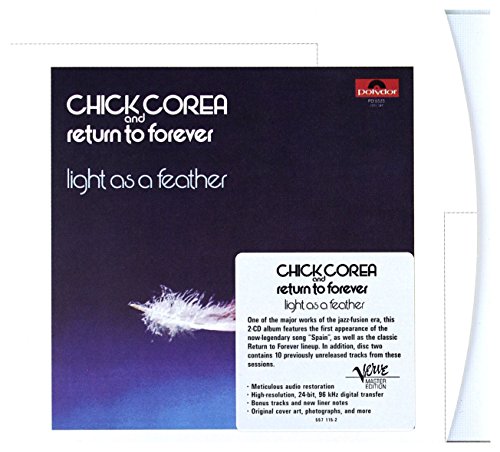
Return to Forever – Light as a Feather (1973)
Recorded in London in October 1972 during the band’s residency at Ronnie Scott’s club, Light as a Feather paired Chick Corea’s Fender Rhodes with Stanley Clarke’s bass, Joe Farrell’s saxophone and flute, and the Brazilian rhythm team of Flora Purim and Airto Moreira, giving early Return to Forever a Latin, largely acoustic-leaning sound that would change completely within a few years.
The album reached number six on Billboard’s jazz chart and won the 1972 Playboy Jazz Album of the Year award, driven largely by “Spain,” whose introduction directly quotes Joaquín Rodrigo’s Concierto de Aranjuez.
Every member of this lineup except Clarke had left the band by its next record, making Light as a Feather a clean snapshot of a version of Return to Forever that barely resembled the harder rock-fusion group it would soon become.
Herbie Hancock – Head Hunters (1973)
Recorded in San Francisco in September 1973 with Bennie Maupin, Paul Jackson, Harvey Mason and Bill Summers, Head Hunters marked Hancock’s deliberate turn away from his more abstract Mwandishi-era material toward groove-based writing built on clavinet, Fender Rhodes and funk basslines closer to Sly Stone than to bebop.
It reached number thirteen on the Billboard 200 and number two on the R&B chart, an extraordinary crossover result, and was later added to the National Recording Registry.
Most sources tag it “jazz-funk” ahead of “jazz fusion,” a useful distinction: where Mahavishnu and early Return to Forever drew on rock and Latin vocabularies, Head Hunters built its fusion almost entirely from funk.