

The clarinet tone of Artie Shaw did not drift.
It cut cleanly through brass sections, cool at the center and precise at the edges. Where other swing-era leaders leaned into warmth or exuberance, Shaw favored clarity. His lines often moved with almost classical poise, even at brisk tempos.
Across the arc of Artie Shaw songs, what becomes apparent is control. The arrangements swing, certainly, but the phrasing rarely spills over. Even in his most popular hits, the melodic contour feels carefully shaped rather than casually improvised.
From Dance Bands to National Spotlight
Born in New York City in 1910, Shaw worked steadily through the early 1930s before assembling the orchestra that would define his place in swing history. By the late 1930s, his recordings were reaching national audiences, propelled by radio play and ballroom demand.
Yet popularity did not soften his approach. Shaw’s bands emphasized tight ensemble passages and refined voicing. His clarinet solos threaded through arrangements with deliberate articulation. The songs that emerged from this period reveal both commercial appeal and musical discipline.
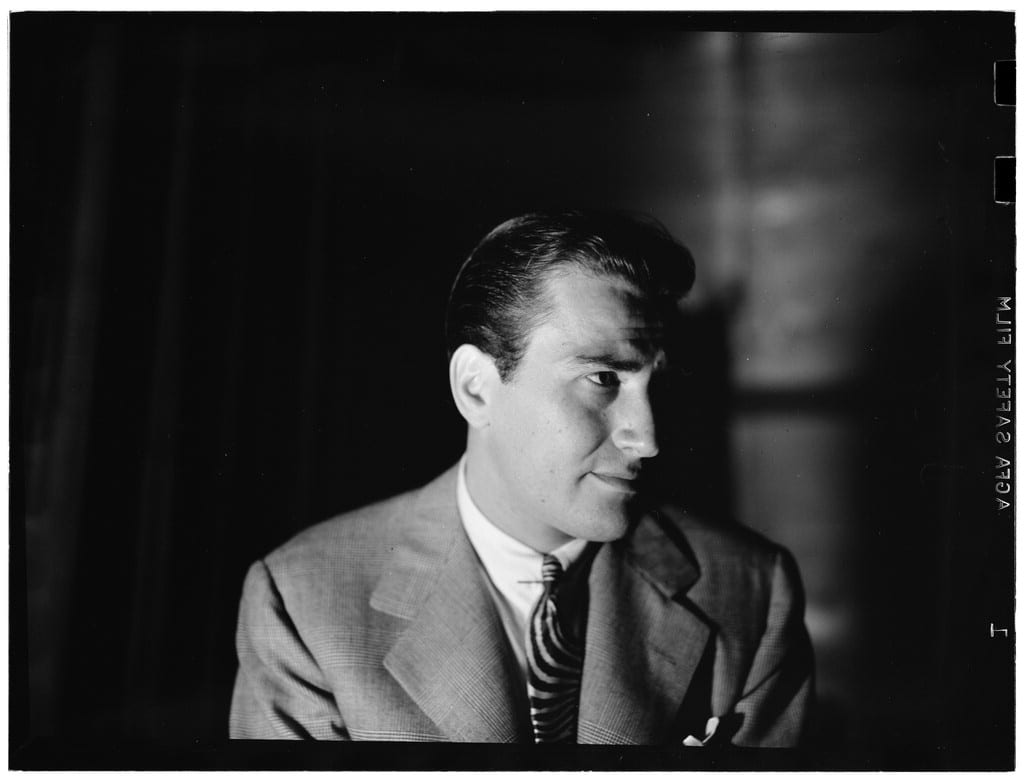
“Begin the Beguine” (1938)
Released in 1938, this Cole Porter adaptation became Shaw’s defining hit. The introduction unfolds gradually, clarinet entering with poised restraint before the full ensemble lifts the tempo into dance-floor momentum.
Shaw’s solo does not overwhelm the structure. Instead, it extends the melody in controlled arcs. The rhythmic feel remains buoyant, but the tone stays centered and cool. The performance’s success reshaped his career overnight, though the musical qualities were already present.
“Nightmare” (1938)
Issued the same year, “Nightmare” offers a darker atmosphere. The opening clarinet line carries a slightly shadowed timbre, supported by subdued brass figures. Rather than driving forward, the arrangement lingers.
The tension builds gradually, sustained by careful dynamic control. It stands as one of the more introspective entries among Artie Shaw songs of the late 1930s.
“Frenesi” (1940)
By 1940, Shaw’s orchestra had matured further. “Frenesi” blends Latin-inflected rhythm with swing-era precision. The arrangement highlights sectional contrast, alternating between tightly arranged passages and fluid clarinet lines.
Shaw navigates the melodic turns without excess flourish. Even in exoticized settings, the phrasing remains disciplined.
“Stardust” (1940)
His reading of Hoagy Carmichael’s “Stardust” emphasizes lyricism over bravura. The clarinet tone softens slightly, and vibrato is applied sparingly. The tempo remains relaxed, allowing melodic phrasing to stretch naturally.
Rather than dramatizing the ballad, Shaw allows it to breathe. The restraint becomes the expressive tool.
“Moonglow” (1941)
In this 1941 recording, Shaw balances swing propulsion with melodic refinement. The ensemble maintains steady momentum while the clarinet lines glide over the rhythmic grid.
The performance underscores his ability to maintain elegance even within dance-oriented formats.
“Concerto for Clarinet” (1941)
Released in 1941, this extended composition blurs boundaries between swing and classical influence. The piece opens with a slow, almost orchestral introduction before transitioning into faster sections.
Shaw’s clarinet explores dynamic range and tonal shading more expansively than in shorter dance numbers. The structure feels ambitious without abandoning accessibility.
Among Artie Shaw songs, this stands as a statement of artistic intent beyond commercial demand.“
“Summit Ridge Drive” (1946)
By the mid-1940s, personnel changes and shifting musical climates had altered the big-band landscape. “Summit Ridge Drive” reflects a slightly more streamlined ensemble sound.
The clarinet lines feel direct and focused. The arrangement avoids heavy ornamentation, favoring clean articulation and rhythmic lift.
“What Is This Thing Called Love?” (1954 – later recordings)
In later recordings of this standard, Shaw’s approach becomes even more distilled. The tempo often relaxes, and the clarinet tone darkens slightly with age.
He avoids virtuosic display, focusing instead on melodic integrity. The performance feels reflective rather than assertive.
A Listening Path Through Artie Shaw Songs
For those exploring his catalogue chronologically:
- “Begin the Beguine” (1938) — breakthrough swing classic
- “Nightmare” (1938) — atmospheric contrast
- “Frenesi” (1940) — Latin-inflected precision
- “Stardust” (1940) — lyrical restraint
- “Concerto for Clarinet” (1941) — extended ambition
- “Summit Ridge Drive” (1946) — postwar refinement
Together they trace a bandleader who balanced commercial success with careful musical construction.
Final Thoughts
Artie Shaw’s recordings reveal a musician attentive to proportion. Even in moments of national popularity, the clarinet voice remains composed. Arrangements swing, yet phrasing never spills into excess.
Across decades, the defining qualities remain clarity and control. The cool center of his tone persists whether navigating dance-floor hits or extended compositions. In a crowded swing era, that restraint became its own form of distinction.