

The music of Anthony Braxton rarely settles into expectation.
Themes appear as diagrams rather than melodies, structures unfold like evolving systems, and improvisation often feels architectural rather than emotive. Yet beneath the surface complexity lies discipline. The music is rarely chaotic. It is designed.
Across Anthony Braxton albums, what becomes clear is not abstraction alone, but method. His recordings move between solo exploration, quartet interplay, and large compositional frameworks, yet each setting reveals the same concern: how sound can be organized without becoming confined.
From AACM Foundations to Early Recognition
Born in Chicago in 1945, Braxton emerged from the creative environment of the Association for the Advancement of Creative Musicians (AACM). That collective encouraged experimentation, self-determination, and structural invention beyond traditional jazz formats. Early performances combined reeds, graphic notation, and open-form improvisation.
By the late 1960s, Braxton had begun recording as a leader, already distinct in tone and concept. His approach would not simply expand free jazz language; it would interrogate the boundaries between jazz, composition, and contemporary classical practice.
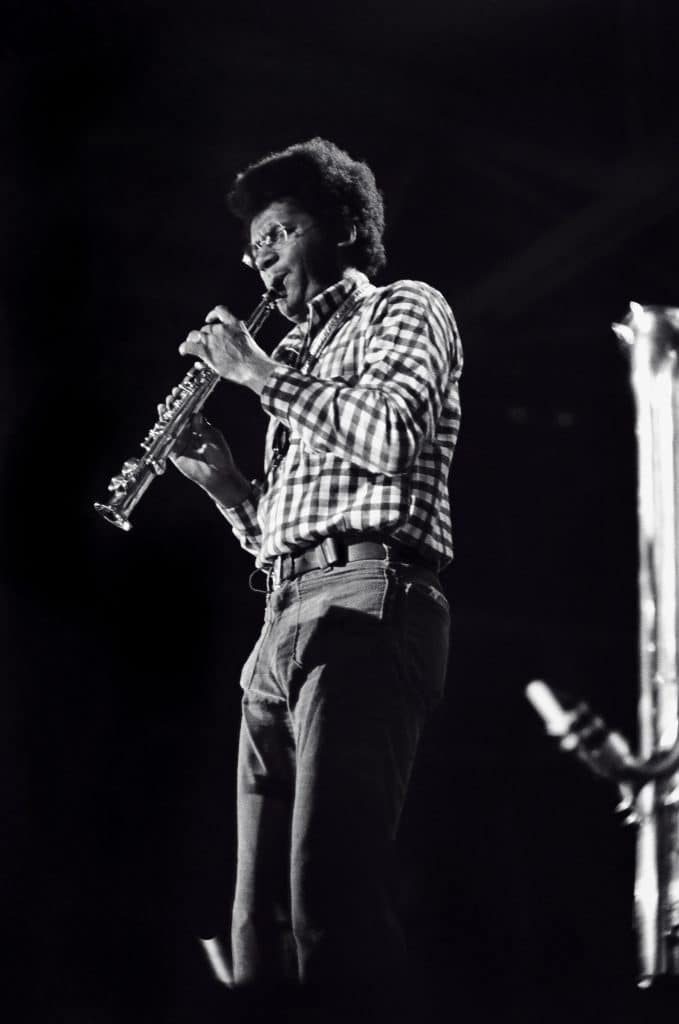
Solo Architecture: For Alto (1969)
Released in 1969, For Alto stands as one of the first solo saxophone albums in modern jazz. There is no rhythm section, no harmonic cushion. Each piece unfolds as a self-contained exploration of timbre, interval, and breath.
Rather than projecting outward, Braxton turns inward. Lines fragment, recombine, and stretch across silence. The absence of accompaniment exposes structural thinking: repetition becomes form, contrast becomes narrative.
Among Anthony Braxton albums, this recording remains foundational — not because of volume, but because of focus.
Quartet Abstraction with Lyric Undercurrent: 3 Compositions of New Jazz (1968 / 1969 release)
Though recorded slightly earlier, its release established Braxton’s early quartet language. The ensemble blends composed frameworks with open improvisation. The themes, often titled numerically rather than descriptively, function as blueprints.
Yet the playing does not feel cold. There are passages of surprising lyricism, especially in the interaction between reeds and rhythm section. Structure guides movement without erasing spontaneity.
Expanding the Ensemble: Creative Orchestra Music 1976 (1976)
By the mid-1970s, Braxton had begun exploring larger orchestral settings. Creative Orchestra Music 1976 demonstrates how his compositional thinking could scale outward. The pieces interweave dense ensemble passages with open improvisational windows.
The textures feel layered but deliberate. Brass clusters dissolve into smaller group dialogues. Notation and freedom coexist rather than compete.
Across Anthony Braxton albums, this recording signals a shift from small-group experimentation to systemic architecture.
Refined Quartet Dialogue: The Montreux/Berlin Concerts (1977)
Live recordings from this period reveal the maturation of his quartet with George Lewis, Dave Holland, and Barry Altschul. The interplay is fluid yet sharply attentive. Themes appear, fracture, then reassemble in altered form.
Braxton’s alto tone cuts cleanly, sometimes piercing, sometimes airy. The group listens intensely, allowing direction to change mid-phrase without losing cohesion.
These performances show complexity becoming conversational rather than confrontational.
Structural Systems in Motion: Six Compositions: Quartet (1981)
The early 1980s brought increasing emphasis on extended compositional systems. Six Compositions: Quartet blends intricate written material with improvisation embedded inside it. Rather than soloing over changes, musicians navigate layered frameworks.
The result feels less like a sequence of tunes and more like an unfolding design. Silence, density, and rhythmic displacement interact continuously.
Ghost Trance Beginnings: Composition No. 94 (1987)
By the late 1980s, Braxton was developing what would become the Ghost Trance Music system — extended melodic lines designed to function as navigational pathways through larger structures.
Composition No. 94 introduces the concept in embryonic form. Repetition acts as grounding device, allowing performers to branch into secondary material before returning to central lines.
It is not minimalist. It is procedural.
Large-Scale Vision: Four Compositions (Quartet) 1995 (1995)
This mid-1990s release shows the Ghost Trance framework gaining clarity. The quartet operates inside long-form pieces that shift gradually rather than abruptly. Themes emerge as sustained currents, occasionally interrupted by contrasting passages.
What distinguishes this period in Anthony Braxton albums is patience. The music does not demand immediate comprehension. It rewards immersion.
Late-Career Synthesis: Quartet (Standards) 2020 (2020)
Released in 2020, this recording reveals another side of Braxton’s practice. Here he revisits standard repertoire, filtering familiar material through his structural sensibility. Melodies remain recognizable, yet phrasing stretches and compresses unpredictably.
Rather than dismantling tradition, he refracts it. The standards become components within a broader conceptual language.
A Listening Route Through Anthony Braxton Albums
For those approaching his catalogue, this progression offers clarity:
- For Alto (1969) — solo structural breakthrough
- 3 Compositions of New Jazz (1969 release) — early quartet abstraction
- Creative Orchestra Music 1976 (1976) — expanded ensemble design
- The Montreux/Berlin Concerts (1977) — live quartet cohesion
- Six Compositions: Quartet (1981) — embedded structural systems
- Four Compositions (Quartet) 1995 (1995) — mature Ghost Trance evolution
- Quartet (Standards) 2020 (2020) — reflective reinterpretation
Together they map a career defined less by genre and more by inquiry.
Final Thoughts
Anthony Braxton’s discography resists casual listening categories. The recordings do not chase immediacy. They examine possibility. Across decades, the underlying concern remains consistent: how improvisation can exist inside designed systems without losing vitality.
The complexity is real, but so is the coherence. Each period builds upon the last, expanding rather than discarding earlier ideas. Across Anthony Braxton albums, structure becomes expressive rather than restrictive — a framework that sustains freedom instead of limiting it.